Tag Archives: 70 MHz

Working radio aurora

Aurora by Clare Kines

Working aurora propagation on the amateur radio bands — especially 50 MHz (6m), 70 MHz (4m), and 144 MHz (2m) — is a thrilling and distinctive experience. Aurora propagation is caused by charged particles from the Sun (usually during a geomagnetic storm) interacting with Earth’s magnetic field, energizing the auroral zone and creating a reflective “curtain” that VHF signals can bounce off.


Basics of Aurora Propagation

  • Occurs at high latitudes, primarily over northern Europe, Canada, and the northern U.S.
  • Reflected signals are scattered (Doppler effect), leading to:
    • Distorted audio — speech sounds harsh or “buzzy”
    • CW and tones are raspy, often called “auroral tone”
  • Reflections are strongest from the northern direction (for Northern Hemisphere operators)
  • Most effective during or just after geomagnetic storms (Kp index ≥ 5)

When to Watch for Aurora

  • Solar cycle activity peaks increase chances
  • Watch for:
    • Solar flares (M or X class)
    • Coronal Mass Ejections (CMEs) reported by NOAA or spaceweather.com
  • Aurora can appear anytime day or night, but late afternoon into evening is often best in Europe

Bands and Techniques

50 MHz (6 metres)

  • Best band for aurora work: long wavelengths reflect better off the curtain
  • SSB and CW both work
  • Beam antenna northward — the reflection often comes from the auroral arc to the north
  • Use high power and narrow bandwidth
  • Signals are typically weak and fluttery
  • Range: ~800–2000 km

70 MHz (4 metres)

  • Less commonly used, but similar behaviour to 50 MHz
  • Aurora QSOs possible with CW and SSB
  • Fewer active stations, but a unique opportunity if you’re licensed for 4m

144 MHz (2 metres)

  • Much more angle-dependent — must beam exactly at the auroral curtain
  • Signals much more distorted; CW heavily preferred
  • Beams must be well aligned — aurora scatter is very directional
  • Aurora “backscatter” can allow contacts in odd directions
  • Best success with CW, high ERP, narrow filtering

s

⚙️ Operating Tips

  1. Use CW or SSB
    • CW is best: tones become a “buzz”, but still readable
    • SSB becomes “growly”, harder to copy but still usable
  2. Point antennas north
    • Slight adjustments can help tune into the auroral arc
  3. Call CQ AURORA
    • Examples: “CQ AUR DE G4MCU or just CQA DE G4MCU”
  4. Listen for others on known calling frequencies:
    • 50.100–50.120 MHz CW/SSB (Europe)
    • 70.200 MHz (CW/SSB)
    • 144.050–144.100 MHz CW
    • 144.300 MHz (SSB calling)
  5. Use narrow filters to reduce flutter and fading
  6. Watch cluster spots and aurora alerts: DX maps, DX cluster, LiveMUF, or aurora watch apps

Example Contact Strategy for JO01 (UK)

  • Beam North or North-East
  • On 6m, call CQ on 50.110 CW, then check 50.120–130 SSB
  • On 2m, call CQ on 144.050 CW, then 144.300 SSB
  • Listen for DL, SM, LA, OH, OZ — common aurora QSO partners
  • During good auroral activity, contacts up to 2000 km possible

Helpful Tools

  • Aurora Alerts: aurorawatch.lancs.ac.uk
  • Kp Index Monitor: NOAA SWPC
  • Real-time spots: DX Maps VHF
  • Spaceweather news: spaceweather.com

Here’s a full Aurora Radio Equipment and operating checklist tailored for working 50, 70, and 144 MHz from JO01 (southeast UK where G4MCU is located) or nearby areas

Equipment Essentials

EquipmentRecommendations
TransceiverAll-mode VHF set (e.g., Icom IC-7100, FT-847, IC-9700)
ModesCW preferred, SSB possible
Power50–100W or more is ideal
AntennaYagi with rotator; minimum 3–5 elements on 2m
PreampMasthead LNA especially useful on 2m
LoggingDigital or paper; record time, station, frequency, mode, direction
FiltersNarrow IF filter (CW ~300 Hz) helpful in auroral flutter conditions
Computer ClockAccurate sync (especially for digital modes like FSK441, if used)

Aurora VHF Operating Checklist (50, 70, 144 MHz)

Equipment Essentials

– Transceiver: All-mode VHF (e.g., Icom IC-7100, FT-847, IC-9700)

– Modes: CW preferred, SSB possible

– Power: 50-100W or more is ideal

– Antennas: Directional Yagi (3-5 elements min. on 2m)

– Preamp: Masthead LNA improves weak signals

– Filters: Narrow IF filter (CW ~300 Hz)

– Accurate computer clock for any digital use (FSK441, MSK144)

Frequencies to Monitor (Europe)

50 MHz:

– CW: 50.090-50.120 MHz

– SSB: 50.130-50.200 MHz

70 MHz:

  • CW/SSB: 70.200 MHz (low activity; be active!)

144 MHz:

  • – CW: 144.050-144.100 MHz
  • – SSB: 144.300 MHz

Operating tips

  • – Beam North/North-East; rotate slowly
  • – Use CW for better readability in flutter
  • – Space CW characters out; slow speeds preferred
  • – Record QSOs for later review
  • – Avoid fast CW/digital unless experienced
  • Aurora Alert System
  • Web Tools:
  • – AuroraWatch UK: aurorawatch.lancs.ac.uk
  • – SolarHam: solarham.net
  • – NOAA SWPC: swpc.noaa.gov
  • – DX Maps: dxmaps.com (select VHF/EU)
  • – LiveMUF: livemuf.com
  • – Twitter: @aurorawatchuk, @TamithaSkovWeb Tools:
  • – AuroraWatch UK: aurorawatch.lancs.ac.uk
  • – SolarHam: solarham.net
  • – NOAA SWPC: swpc.noaa.gov
  • – DX Maps: dxmaps.com (select VHF/EU)
  • – LiveMUF: livemuf.com
  • – Twitter: @aurorawatchuk, @TamithaSkov
  • – Mobile apps: Aurora Alerts, My Aurora Forecast, HamAlert

When to Operate

– Kp Index 5+: aurora possible; 6-8 very likely

– After CME or geomagnetic storm alert (G1-G3)

– M or X class solar flares with CME potential

– Best in afternoon/evening but can occur anytime

Sample Operating Schedule

16:00-18:00: 50 MHz CW calling and monitoring

18:00-19:30: 144 MHz CW/SSB, beam north

19:30-20:30: Try 70.200 MHz CW/SSB

20:30-22:00: Return to 6m/2m as aurora builds

Overnight: Check 6m occasionally if storm strong


Transequatorial propagation on four metres

I mentioned in a previous post that I had a brief chat with Dick ZS6BUN over dinner at the RSGB Convention. He talked about VHF activity in South Africa and we each have an IC-9700. QRZ.com informs us that he is interested in weak signal work at VHF. Dick touched on the subject of TEP on six metres. Of course, not everyone at the table was into VHF so it was only a brief conversation on the subject.

In one of the 70 MHz groups to which I belong, someone drew our attention to a quote from the RSGB website:

“For some years stations in South Africa (ZS) have had a 70MHz allocation. The 9000km path between the UK and South Africa is particularly interesting as both ends lie at the extremity of the trans-equatorial zones. A contact over this TEP path is quite possible around Sunspot maximum and should take place when conditions are particularly good on the 50MHz band. Possible openings between the UK and South Africa will probably occur during the month of October.”

I am a newcomer or at least very late returner to 4 metres; I have limited experience and 50 watts to a quarter-wave vertical. However, I am very much interested in VHF propagation and was surprised by the comment about TEP on 70 MHz as far as the UK is concerned.

I emailed Dick in South Africa to ask him if he had any knowledge about this. He replied that he worked TEP on 50 MHz but was not equipped for 70 MHz However his friend Willem ZS6WAB is active on four metres TEP and has been for quite a long time. This was useful information and set me on the trail to find out more.

It turns out that Willem has worked into Europe on 4 metres and it looks as though he is the SSB record holder for distance although there is one longer into Italy via ISCAT. So there have been TEP QSOs between South Africa and Rome and to Mallorca.

What I cannot find is any reference to 70 MHz TEP QSOs further north in Europe, and apparently not to UK.

I would welcome any additional information. It is just conceivable that UK – South Africa contacts at 70 MHz could be made via TEP and some other mode of propagation, maybe very enhanced tropo, even Sporadic E, but both SpE and TEP are seasonal (SpE around the solstices and TEP around the equinoxes) so they may not coincide. TEP is apparently via chordal hop relying on two reflections via the F layer without an intervening ground reflection. One of my correspondents has suggested that the “geometry” may not be right for contacts beyond around 7,500 km on four metres. Has that distance been exceeded? I do not know.

Sporadic E and a tale of the unexpected

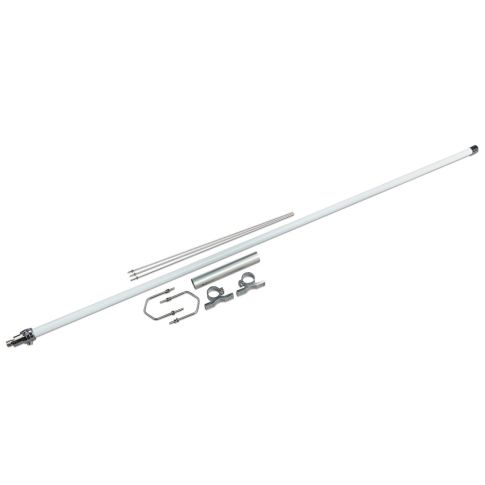
MOONRAKER 70MHz Base Vertical Antenna

An exciting couple of days after my previous post about working the Spanish station on 4 metres!

Yesterday things started to happen on 144 MHz and in just over 20 minutes from 1510z I worked IK0FTA, IK0SMG, IK0RMR, and IK0BZY all in JN61, all 59. I did not hear anything else in terms of DX on the band though some other stations did. I felt pretty pleased with this “haul.”

Then, much to my surprise (again) having gone back to 70 MHz for a look just after 1800z I worked 9A2SB (JN95) and 9A1Z (JN86). My 50 watts SSB and small Moonraker vertical are doing well, far better than I hoped. I think I rather like 4 metres. I certainly did not expect this sort of DX on 4 with the antenna I have, but this is terrific! I have worked just four squares and three of them are rather distant, and 9A2SB is nearly 1,500 km away.

One giant leap on 70 MHz

Moonraker vertical antenna SQBM412

As I mentioned last time, I purchased a small vertical antenna for four metres. It is the Moonraker SQBM412. A friend of mine, Mike, G8EFG kindly installed it on my garage roof a couple of weeks ago, and it is only less than four metres above ground, although my QTH is quite decent for VHF.

Activity is lower than I had hoped on 70 MHz and I had managed to find just one station which was an FM contact. Then last Friday, 3rd June I heard a station on SSB calling CQ at about 30 miles distant. He was very weak. I called him but he either did not hear me or he was looking for DX as there seemed a possibility of Sporadic E propagation for better appointed stations than mine.

Then tuning around I heard EA4CZV calling CQ DX and I called him more in hope than expectation. After some persistence on both sides we completed the SSB contact and I have IN80 as a new square and actually only my second one as the other is the guy down the road I worked on FM.

Of course, with a vertical and not a yagi I have little or no antenna gain but maybe the polarisation factor is less critical at this sort of distance, which was 1280 km, not to be sniffed at.

I am therefore very pleased with the antenna and have said so in my review. Maybe I can work some more DX with it on four metres. It is going to be fun trying!

Progress re 70 MHz

I have put my money where my mouth is as they say and have purchased a small vertical antenna for four metres, or 70 MHz if you prefer. I have also acquired a stand to put it on, with a short pole to which to clamp it. I just need some help to put it where I want it, so that is the next step.

Of course, a small vertical is quite modest as opposed to a yagi for 4, but with the Sporadic E season coming up I might work a little DX, especially as polarisation may not be critical over the long paths of Es propagation. I hope I will be on the air in time to find out, with my IC-7100, which is still in the box it came in. I shall see…

I also look forward to working stations in the UK too. I gather activity is not high, but there are apparently pockets of amateurs active in various localities. I certainly want to give 70 MHz a good go and will put on my thinking cap about 50 MHz too.