Tag Archives: Sporadic E

Sporadic E (Es) propagation

Working amateur radio on 50 MHz (6m), 70 MHz (4m), and 145 MHz (2m) via sporadic E (Es) is an exciting way to achieve long-distance contacts—especially across Europe and into North Africa and the Middle East—without needing high power or large antennas. The most fun in my opinion is in SSB and FM contacts although some prefer sticking to digital modes. Here’s how to time your operation, understand the nature of Es, and adopt best working practices.

Understanding Sporadic E (Es)

Sporadic E is caused by dense patches of ionization in the E-layer (around 90–130 km altitude). These patches reflect VHF signals over distances typically ranging from 600–2200 km, sometimes more with multi-hop.

Frequencies Affected:

  • 50 MHz (6m): Most frequent Es band. Regular every year.
  • 70 MHz (4m): Needs stronger ionization. Opens slightly less often than 6m.
  • 145 MHz (2m): Much rarer. Es at 2m requires exceptionally strong events.

Timing and Incidence of Openings

Best Seasons

  • Late May to mid-August (Northern Hemisphere Es season).
  • Peak activity: Around the summer solstice (June 15–30).
  • A secondary winter Es season sometimes occurs in December–January, mainly below 50 MHz.

Daily Patterns

  • Es peaks often follow this pattern:
    • Late morning: 09:00–11:00 UTC
    • Afternoon spike: 14:00–17:00 UTC
    • Occasional late evening events up to 21:00 UTC

Best Working Practices

1. Monitoring & Early Alerts

  • Use DX clusters: DXMaps, PSKReporter, and DXHeat
  • Watch 6m FT8 activity as an Es “early warning” for potential 4m and 2m openings
  • Keep an eye on real-time MUF maps (Maximum Usable Frequency), especially over 100 MHz
  • Look in the mornings for activity on 70 MHz. If present than I have found 144 MHz Es is possible during the day.

2. Modes & Frequencies

BandModeCommon Es Frequencies
50 MHzSSB, CW, FT850.130 USB (SSB), 50.313 (FT8)
70 MHzSSB, CW, FT870.200 USB (SSB), 70.154 (FT8)
145 MHzSSB, CW, FT8144.300 USB (SSB), 144.174 (FT8

3. Calling Technique

  • Use short, efficient callsigns and reports
  • Avoid long CQ calls during marginal openings
  • Grid square exchange is essential on FT8, e.g., JO01, KN34, etc.
  • Monitor several frequencies (split receiver, SDR waterfall view) if possible

4. Be Ready!

  • Keep equipment on and tuned to the right frequency during peak hours
  • Have macros pre-prepared in WSJT-X for FT8
  • Record or log signal reports even if no QSO—good data for propagation study

Equipment Tips

  • 50/70 MHz: Modest antennas (dipoles, small Yagis) and 50–100W are enough
  • 145 MHz: High-gain Yagis (e.g., 9–13 elements) and high elevation help; Es here is rare, so fast QSO techniques (e.g. FT8, CW) are critical

Typical Paths from UK (JO01)

  • 50 MHz: Into southern Europe, Eastern Europe, Baltic, North Africa, and Middle East
  • 70 MHz: Similar paths but fewer openings; more selective
  • 145 MHz: Only during very strong Es—often to Italy, the Balkans, or Spain

Summary: Working Es on VHF

ElementRecommendation
TimingMay–August, 09–17 UTC
Band Focus50 MHz → 70 MHz → 145 MHz as Es strengthens
ModesFT8 for weak/short openings, SSB for traditional DX
ToolsDXMaps, PSKReporter, WSJT-X, good logbook
AntennasYagis (2m/4m), horizontal polarization preferred
EtiquetteShort calls, efficient exchanges, quick QSL/logging

I hope you find this useful. I am posting it during the summertime Sporadic E season but bear in mind Es can be present as late as September as well as around the winter solstice.

Mostly 144 MHz Sporadic E June and July 2023

It seems the Sporadic E season is pretty much over, and it has been a fairly poor one, as even 50 MHz enthusiasts are saying. Anyway, here is my mostly 2 metres DX summary for June and July 2023.

Sporadic E

5.6.23              HA8AR          KN06

                        LZ2LY            KN13

                        HA3KZ           JN97

13.6.23            LZ1ZP KN22

                        LZ2ZY            KN13

15.6.23            I7CSB JN71

                        IK7RWE         JN80

                        IK7JNM          JN80

                        IK7BZY         JN61

                        IK8HJC          JN70

                        LZ1RDD         KN12

                        E73O              JN95

6.6.23 Re tropo, several OZs, JO45, JO46, JO44 and a German JO54 and the two on 7th.

7.6.23 SM7EYW JO65

            DK5HQ JO53

On 70 cms OV3T JO46 was a huge signal 13.6.23 in the contest and worked him on SSB of course but had to go QRT so I don’t know what else was about. All seemed gone the following morning.

A bit more Sporadic E fun in the afternoon, 9th July.

All 2 metres SSB

IZ7FLS/6 JN62

IK7EOT JN80

IZ6ZER JN63

IZ7UMS JN81

IZ7DPB JN80

It all lasted about 40 minutes here from the first at 1608z. Others may well have worked more.

I am happy with what I worked but Sporadic E has been very sporadic this summer.

Transequatorial propagation on four metres

I mentioned in a previous post that I had a brief chat with Dick ZS6BUN over dinner at the RSGB Convention. He talked about VHF activity in South Africa and we each have an IC-9700. QRZ.com informs us that he is interested in weak signal work at VHF. Dick touched on the subject of TEP on six metres. Of course, not everyone at the table was into VHF so it was only a brief conversation on the subject.

In one of the 70 MHz groups to which I belong, someone drew our attention to a quote from the RSGB website:

“For some years stations in South Africa (ZS) have had a 70MHz allocation. The 9000km path between the UK and South Africa is particularly interesting as both ends lie at the extremity of the trans-equatorial zones. A contact over this TEP path is quite possible around Sunspot maximum and should take place when conditions are particularly good on the 50MHz band. Possible openings between the UK and South Africa will probably occur during the month of October.”

I am a newcomer or at least very late returner to 4 metres; I have limited experience and 50 watts to a quarter-wave vertical. However, I am very much interested in VHF propagation and was surprised by the comment about TEP on 70 MHz as far as the UK is concerned.

I emailed Dick in South Africa to ask him if he had any knowledge about this. He replied that he worked TEP on 50 MHz but was not equipped for 70 MHz However his friend Willem ZS6WAB is active on four metres TEP and has been for quite a long time. This was useful information and set me on the trail to find out more.

It turns out that Willem has worked into Europe on 4 metres and it looks as though he is the SSB record holder for distance although there is one longer into Italy via ISCAT. So there have been TEP QSOs between South Africa and Rome and to Mallorca.

What I cannot find is any reference to 70 MHz TEP QSOs further north in Europe, and apparently not to UK.

I would welcome any additional information. It is just conceivable that UK – South Africa contacts at 70 MHz could be made via TEP and some other mode of propagation, maybe very enhanced tropo, even Sporadic E, but both SpE and TEP are seasonal (SpE around the solstices and TEP around the equinoxes) so they may not coincide. TEP is apparently via chordal hop relying on two reflections via the F layer without an intervening ground reflection. One of my correspondents has suggested that the “geometry” may not be right for contacts beyond around 7,500 km on four metres. Has that distance been exceeded? I do not know.

Sporadic E and a tale of the unexpected

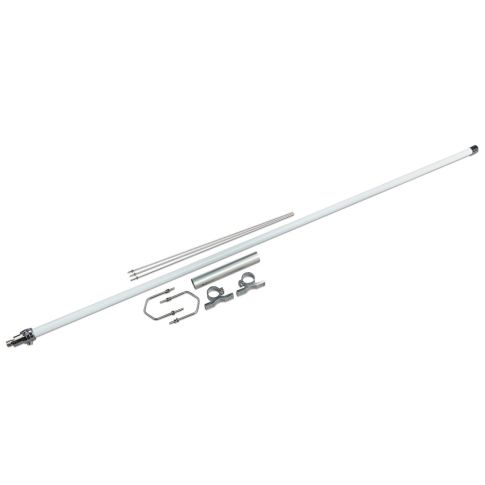
MOONRAKER 70MHz Base Vertical Antenna

An exciting couple of days after my previous post about working the Spanish station on 4 metres!

Yesterday things started to happen on 144 MHz and in just over 20 minutes from 1510z I worked IK0FTA, IK0SMG, IK0RMR, and IK0BZY all in JN61, all 59. I did not hear anything else in terms of DX on the band though some other stations did. I felt pretty pleased with this “haul.”

Then, much to my surprise (again) having gone back to 70 MHz for a look just after 1800z I worked 9A2SB (JN95) and 9A1Z (JN86). My 50 watts SSB and small Moonraker vertical are doing well, far better than I hoped. I think I rather like 4 metres. I certainly did not expect this sort of DX on 4 with the antenna I have, but this is terrific! I have worked just four squares and three of them are rather distant, and 9A2SB is nearly 1,500 km away.

One giant leap on 70 MHz

Moonraker vertical antenna SQBM412

As I mentioned last time, I purchased a small vertical antenna for four metres. It is the Moonraker SQBM412. A friend of mine, Mike, G8EFG kindly installed it on my garage roof a couple of weeks ago, and it is only less than four metres above ground, although my QTH is quite decent for VHF.

Activity is lower than I had hoped on 70 MHz and I had managed to find just one station which was an FM contact. Then last Friday, 3rd June I heard a station on SSB calling CQ at about 30 miles distant. He was very weak. I called him but he either did not hear me or he was looking for DX as there seemed a possibility of Sporadic E propagation for better appointed stations than mine.

Then tuning around I heard EA4CZV calling CQ DX and I called him more in hope than expectation. After some persistence on both sides we completed the SSB contact and I have IN80 as a new square and actually only my second one as the other is the guy down the road I worked on FM.

Of course, with a vertical and not a yagi I have little or no antenna gain but maybe the polarisation factor is less critical at this sort of distance, which was 1280 km, not to be sniffed at.

I am therefore very pleased with the antenna and have said so in my review. Maybe I can work some more DX with it on four metres. It is going to be fun trying!

Sporadic E on 2 metres at G4MCU so far in 2020

Firstly, the good news. On 25th May I worked LZ1ZP in KN22 during the afternoon. On 29th May I worked IT9YLF in JM68 and 9H1TX in JM75 (worked before in 2019). After a couple of failures with stations I then worked IZ8DSX in JN71.

On 31st May I worked IK8EVE in JN71, whom I also worked in 2019.

The big disappointment was the big opening on 29th May when I heard many stations but did not complete with most. The problem was getting through the pile ups, given that I am in JO01 which is a densely populated square hence lots of stations were hearing and calling the same people as I was.  I heard UT3UX, UT9UR, UR5RQP, 9A2B and 9A2RD. Had I been logging as an SWL I would have been delighted. As it was, I ended up disappointed. Still, not working stuff I wanted is not the end of the world, is it?