Tag Archives: VHF DX

Working meteor scatter on 2 metres

Meteors photo by Baris Karagoz with thanks.

Back in the Eighties I was active on meteor scatter using high speed course with a keyer at 1000 letters a minute (200 lpm), a modified cassette recorder to copy and slow down signals received, and my trusty FT221R. It is a different world now with the new digital technology, so this is an up-to-date summary of current practice.

Working meteor scatter (MS) on 144 MHz (2 meters) is a fascinating part of VHF amateur radio that uses ionized trails left by meteors in the upper atmosphere to reflect radio signals over distances typically between 500 to 2,300 km. Here’s a detailed guide to getting started:


Essential Equipment

  1. Transceiver
    • A VHF rig capable of operating on 144–148 MHz SSB (preferably with USB).
    • Minimum 50 watts output; 100+ watts is better.
  2. Antenna
    • High-gain Yagi (e.g., 10–13 elements).
    • Horizontally polarized.
    • Elevated on a rotator is ideal for aiming toward target stations.
  3. Computer and Software
    • Windows PC or Linux/Mac with emulation.
    • WSJT-X software (by Joe Taylor, K1JT).
    • Audio interface (e.g., SignaLink or rig’s built-in soundcard support).
  4. Time Sync
    • Accurate clock (use software like Dimension 4 or Meinberg NTP to keep your PC within 1 second of UTC).

Basic Meteor Scatter Operating Principles

  • Meteor scatter works best in early mornings (peak meteor activity around local sunrise).
  • Most meteors are small but frequent—so-called “sporadic meteors”.
  • Larger showers (like Perseids, Quadrantids, Geminids) offer longer bursts and better conditions.

⚙️ Digital Mode: MSK144 (Preferred Mode)

MSK144 is designed for fast meteor scatter on 6 and 2 meters.

Operating Cycle

  • Transmissions are synchronized in 15-second intervals.
  • Example: You transmit on even minutes (:00, :15, :30, :45), the other station on odd.
  • Ensure UTC clock sync!

Calling Procedure

  1. Set frequency:
    • 144.360 MHz USB is common in Europe.
    • 50.260 MHz for 6m (if you move to 50 MHz later).
  2. Call CQ using WSJT-X (MSK144 mode):
    • Select “Tx Even” or “Tx Odd” appropriately.
    • Set the correct audio levels (watch ALC on radio).
    • Watch for decoded bursts in WSJT-X waterfall and text pane.
  3. Exchange Format:
    • Call signs → Reports (e.g., R26) → RRR → 73.

When to Operate?

Best Meteor Showers for MS:

ShowerPeak DateComment
QuadrantidsJan 3–4Short, intense
PerseidsAug 12–13Long peak, very active
GeminidsDec 13–14Reliable, strong signals

1. Equipment Setup

Core Station Checklist

ItemRecommended SpecNotes
RadioAll-mode VHF (e.g., IC-9700, FT-847, TS-2000)Must support USB
Power≥ 100 watts (brick amp like RM Italy LA250 ok)Higher power = stronger pings
Antenna10–13 element Yagi, horizontally polarizede.g., M2 2M9SSB or LFA Yagi
FeedlineLow-loss coax (LMR-400, Ecoflex 10, or better)Keep runs short
PreampMast-mounted LNA (optional but helps)Use RX coax bypass if TX power is high
PC InterfaceRig soundcard or external USB interface (e.g., Signalink)Must support VOX or CAT control
Time SyncMeinberg NTP, Dimension 4, or GPS time sourceCritical! Clock must be within ±1 sec UTC
SoftwareWSJT-X (latest stable), MSK144 modeAlso install JTAlert if you want assistance


I hope you found the above useful, and will give MS a go.

Working radio aurora

Aurora by Clare Kines

Working aurora propagation on the amateur radio bands — especially 50 MHz (6m), 70 MHz (4m), and 144 MHz (2m) — is a thrilling and distinctive experience. Aurora propagation is caused by charged particles from the Sun (usually during a geomagnetic storm) interacting with Earth’s magnetic field, energizing the auroral zone and creating a reflective “curtain” that VHF signals can bounce off.


Basics of Aurora Propagation

  • Occurs at high latitudes, primarily over northern Europe, Canada, and the northern U.S.
  • Reflected signals are scattered (Doppler effect), leading to:
    • Distorted audio — speech sounds harsh or “buzzy”
    • CW and tones are raspy, often called “auroral tone”
  • Reflections are strongest from the northern direction (for Northern Hemisphere operators)
  • Most effective during or just after geomagnetic storms (Kp index ≥ 5)

When to Watch for Aurora

  • Solar cycle activity peaks increase chances
  • Watch for:
    • Solar flares (M or X class)
    • Coronal Mass Ejections (CMEs) reported by NOAA or spaceweather.com
  • Aurora can appear anytime day or night, but late afternoon into evening is often best in Europe

Bands and Techniques

50 MHz (6 metres)

  • Best band for aurora work: long wavelengths reflect better off the curtain
  • SSB and CW both work
  • Beam antenna northward — the reflection often comes from the auroral arc to the north
  • Use high power and narrow bandwidth
  • Signals are typically weak and fluttery
  • Range: ~800–2000 km

70 MHz (4 metres)

  • Less commonly used, but similar behaviour to 50 MHz
  • Aurora QSOs possible with CW and SSB
  • Fewer active stations, but a unique opportunity if you’re licensed for 4m

144 MHz (2 metres)

  • Much more angle-dependent — must beam exactly at the auroral curtain
  • Signals much more distorted; CW heavily preferred
  • Beams must be well aligned — aurora scatter is very directional
  • Aurora “backscatter” can allow contacts in odd directions
  • Best success with CW, high ERP, narrow filtering

s

⚙️ Operating Tips

  1. Use CW or SSB
    • CW is best: tones become a “buzz”, but still readable
    • SSB becomes “growly”, harder to copy but still usable
  2. Point antennas north
    • Slight adjustments can help tune into the auroral arc
  3. Call CQ AURORA
    • Examples: “CQ AUR DE G4MCU or just CQA DE G4MCU”
  4. Listen for others on known calling frequencies:
    • 50.100–50.120 MHz CW/SSB (Europe)
    • 70.200 MHz (CW/SSB)
    • 144.050–144.100 MHz CW
    • 144.300 MHz (SSB calling)
  5. Use narrow filters to reduce flutter and fading
  6. Watch cluster spots and aurora alerts: DX maps, DX cluster, LiveMUF, or aurora watch apps

Example Contact Strategy for JO01 (UK)

  • Beam North or North-East
  • On 6m, call CQ on 50.110 CW, then check 50.120–130 SSB
  • On 2m, call CQ on 144.050 CW, then 144.300 SSB
  • Listen for DL, SM, LA, OH, OZ — common aurora QSO partners
  • During good auroral activity, contacts up to 2000 km possible

Helpful Tools

  • Aurora Alerts: aurorawatch.lancs.ac.uk
  • Kp Index Monitor: NOAA SWPC
  • Real-time spots: DX Maps VHF
  • Spaceweather news: spaceweather.com

Here’s a full Aurora Radio Equipment and operating checklist tailored for working 50, 70, and 144 MHz from JO01 (southeast UK where G4MCU is located) or nearby areas

Equipment Essentials

EquipmentRecommendations
TransceiverAll-mode VHF set (e.g., Icom IC-7100, FT-847, IC-9700)
ModesCW preferred, SSB possible
Power50–100W or more is ideal
AntennaYagi with rotator; minimum 3–5 elements on 2m
PreampMasthead LNA especially useful on 2m
LoggingDigital or paper; record time, station, frequency, mode, direction
FiltersNarrow IF filter (CW ~300 Hz) helpful in auroral flutter conditions
Computer ClockAccurate sync (especially for digital modes like FSK441, if used)

Aurora VHF Operating Checklist (50, 70, 144 MHz)

Equipment Essentials

– Transceiver: All-mode VHF (e.g., Icom IC-7100, FT-847, IC-9700)

– Modes: CW preferred, SSB possible

– Power: 50-100W or more is ideal

– Antennas: Directional Yagi (3-5 elements min. on 2m)

– Preamp: Masthead LNA improves weak signals

– Filters: Narrow IF filter (CW ~300 Hz)

– Accurate computer clock for any digital use (FSK441, MSK144)

Frequencies to Monitor (Europe)

50 MHz:

– CW: 50.090-50.120 MHz

– SSB: 50.130-50.200 MHz

70 MHz:

  • CW/SSB: 70.200 MHz (low activity; be active!)

144 MHz:

  • – CW: 144.050-144.100 MHz
  • – SSB: 144.300 MHz

Operating tips

  • – Beam North/North-East; rotate slowly
  • – Use CW for better readability in flutter
  • – Space CW characters out; slow speeds preferred
  • – Record QSOs for later review
  • – Avoid fast CW/digital unless experienced
  • Aurora Alert System
  • Web Tools:
  • – AuroraWatch UK: aurorawatch.lancs.ac.uk
  • – SolarHam: solarham.net
  • – NOAA SWPC: swpc.noaa.gov
  • – DX Maps: dxmaps.com (select VHF/EU)
  • – LiveMUF: livemuf.com
  • – Twitter: @aurorawatchuk, @TamithaSkovWeb Tools:
  • – AuroraWatch UK: aurorawatch.lancs.ac.uk
  • – SolarHam: solarham.net
  • – NOAA SWPC: swpc.noaa.gov
  • – DX Maps: dxmaps.com (select VHF/EU)
  • – LiveMUF: livemuf.com
  • – Twitter: @aurorawatchuk, @TamithaSkov
  • – Mobile apps: Aurora Alerts, My Aurora Forecast, HamAlert

When to Operate

– Kp Index 5+: aurora possible; 6-8 very likely

– After CME or geomagnetic storm alert (G1-G3)

– M or X class solar flares with CME potential

– Best in afternoon/evening but can occur anytime

Sample Operating Schedule

16:00-18:00: 50 MHz CW calling and monitoring

18:00-19:30: 144 MHz CW/SSB, beam north

19:30-20:30: Try 70.200 MHz CW/SSB

20:30-22:00: Return to 6m/2m as aurora builds

Overnight: Check 6m occasionally if storm strong


Sporadic E (Es) propagation

Working amateur radio on 50 MHz (6m), 70 MHz (4m), and 145 MHz (2m) via sporadic E (Es) is an exciting way to achieve long-distance contacts—especially across Europe and into North Africa and the Middle East—without needing high power or large antennas. The most fun in my opinion is in SSB and FM contacts although some prefer sticking to digital modes. Here’s how to time your operation, understand the nature of Es, and adopt best working practices.

Understanding Sporadic E (Es)

Sporadic E is caused by dense patches of ionization in the E-layer (around 90–130 km altitude). These patches reflect VHF signals over distances typically ranging from 600–2200 km, sometimes more with multi-hop.

Frequencies Affected:

  • 50 MHz (6m): Most frequent Es band. Regular every year.
  • 70 MHz (4m): Needs stronger ionization. Opens slightly less often than 6m.
  • 145 MHz (2m): Much rarer. Es at 2m requires exceptionally strong events.

Timing and Incidence of Openings

Best Seasons

  • Late May to mid-August (Northern Hemisphere Es season).
  • Peak activity: Around the summer solstice (June 15–30).
  • A secondary winter Es season sometimes occurs in December–January, mainly below 50 MHz.

Daily Patterns

  • Es peaks often follow this pattern:
    • Late morning: 09:00–11:00 UTC
    • Afternoon spike: 14:00–17:00 UTC
    • Occasional late evening events up to 21:00 UTC

Best Working Practices

1. Monitoring & Early Alerts

  • Use DX clusters: DXMaps, PSKReporter, and DXHeat
  • Watch 6m FT8 activity as an Es “early warning” for potential 4m and 2m openings
  • Keep an eye on real-time MUF maps (Maximum Usable Frequency), especially over 100 MHz
  • Look in the mornings for activity on 70 MHz. If present than I have found 144 MHz Es is possible during the day.

2. Modes & Frequencies

BandModeCommon Es Frequencies
50 MHzSSB, CW, FT850.130 USB (SSB), 50.313 (FT8)
70 MHzSSB, CW, FT870.200 USB (SSB), 70.154 (FT8)
145 MHzSSB, CW, FT8144.300 USB (SSB), 144.174 (FT8

3. Calling Technique

  • Use short, efficient callsigns and reports
  • Avoid long CQ calls during marginal openings
  • Grid square exchange is essential on FT8, e.g., JO01, KN34, etc.
  • Monitor several frequencies (split receiver, SDR waterfall view) if possible

4. Be Ready!

  • Keep equipment on and tuned to the right frequency during peak hours
  • Have macros pre-prepared in WSJT-X for FT8
  • Record or log signal reports even if no QSO—good data for propagation study

Equipment Tips

  • 50/70 MHz: Modest antennas (dipoles, small Yagis) and 50–100W are enough
  • 145 MHz: High-gain Yagis (e.g., 9–13 elements) and high elevation help; Es here is rare, so fast QSO techniques (e.g. FT8, CW) are critical

Typical Paths from UK (JO01)

  • 50 MHz: Into southern Europe, Eastern Europe, Baltic, North Africa, and Middle East
  • 70 MHz: Similar paths but fewer openings; more selective
  • 145 MHz: Only during very strong Es—often to Italy, the Balkans, or Spain

Summary: Working Es on VHF

ElementRecommendation
TimingMay–August, 09–17 UTC
Band Focus50 MHz → 70 MHz → 145 MHz as Es strengthens
ModesFT8 for weak/short openings, SSB for traditional DX
ToolsDXMaps, PSKReporter, WSJT-X, good logbook
AntennasYagis (2m/4m), horizontal polarization preferred
EtiquetteShort calls, efficient exchanges, quick QSL/logging

I hope you find this useful. I am posting it during the summertime Sporadic E season but bear in mind Es can be present as late as September as well as around the winter solstice.

Tropospheric propagation at VHF

I have tried hard to get interest in VHF working through my talks at local radio clubs but without much success. Here is a little information for a wider audience.

Tropospheric propagation is a key mode of signal transmission in the VHF (Very High Frequency) and UHF (Ultra High Frequency) bands, particularly between 70 MHz (4-meter band) and 1296 MHz (1.2 GHz, or 23 cm band). Here’s a detailed overview tailored to these frequencies:


Tropospheric Propagation Basics

Tropospheric propagation refers to the bending (refraction), reflection, or ducting of radio waves in the lowest layer of Earth’s atmosphere — the troposphere (up to ~10-15 km altitude). Variations in temperature, pressure, and humidity create refractive index gradients that affect radio signals.


1. Tropospheric Refraction

  • Always present, but often weak.
  • Causes signals to bend slightly, extending line-of-sight range (~15–30% more).
  • Most noticeable in the lower VHF (e.g., 70 MHz) and UHF bands.

2. Tropospheric Ducting

  • Occurs under temperature inversions where warm air overlays cooler air.
  • Creates a “duct” that traps radio waves, enabling them to travel hundreds to over 1000 km.
  • Most common during high-pressure systems, especially over water or flat terrain.
  • Strongest on UHF bands (432 MHz and above), but noticeable at 144 MHz as well.
  • Can support 70 MHz contacts too, but less common due to the wavelength being more sensitive to terrain and atmospheric scattering.

3. Tropospheric Scattering

  • Weak propagation mode allowing signals to travel 100–500 km.
  • Caused by small-scale irregularities in the troposphere.
  • Common across all these bands, but requires high power and gain (especially above 432 MHz).
  • Used for beyond-line-of-sight links in commercial and military systems.

Frequency Dependence Overview

Frequency BandTroposcatterRefraction GainDucting PotentialNotes
70 MHzModerateGoodRare/WeakSimilar to HF/VHF hybrid behaviour
144 MHzGoodGoodOccasionalTropospheric openings can span hundreds of km
432 MHzVery GoodModerateFrequentStrong ducting over oceans or flat land
1.2 GHzExcellentLowerStrong/SharpSharp signal peaks, strong ducting but more line-of-sight dependence

Practical Implications for Radio Amateurs

  • DXing on 144 MHz and above often depends on tropospheric ducting — watch for high-pressure systems, especially over the sea.
  • Beacons and APRS networks are useful to monitor tropo openings.
  • Weather tools (like Hepburn maps or radiosonde data) can predict ducting potential.
  • Higher frequencies (e.g., 1.2 GHz) may experience “knife-edge” sharpness in ducting — strong signals or none at all.

🛰️ Tools for Monitoring & Forecasting


If you’re using modes like FT8, SSB, or CW, tropo can extend your range significantly. Narrowband digital modes are especially useful during marginal tropo conditions at 432 MHz and 1.2 GHz.

It is a common myth that VHF propagation is line of sight, but even under “flat” conditions this is simply not so. 400 km range is often possible given suitable power and antenna. Have a go if you haven’t, starting with 2 metres, SSB or CW!

My VHF Journey

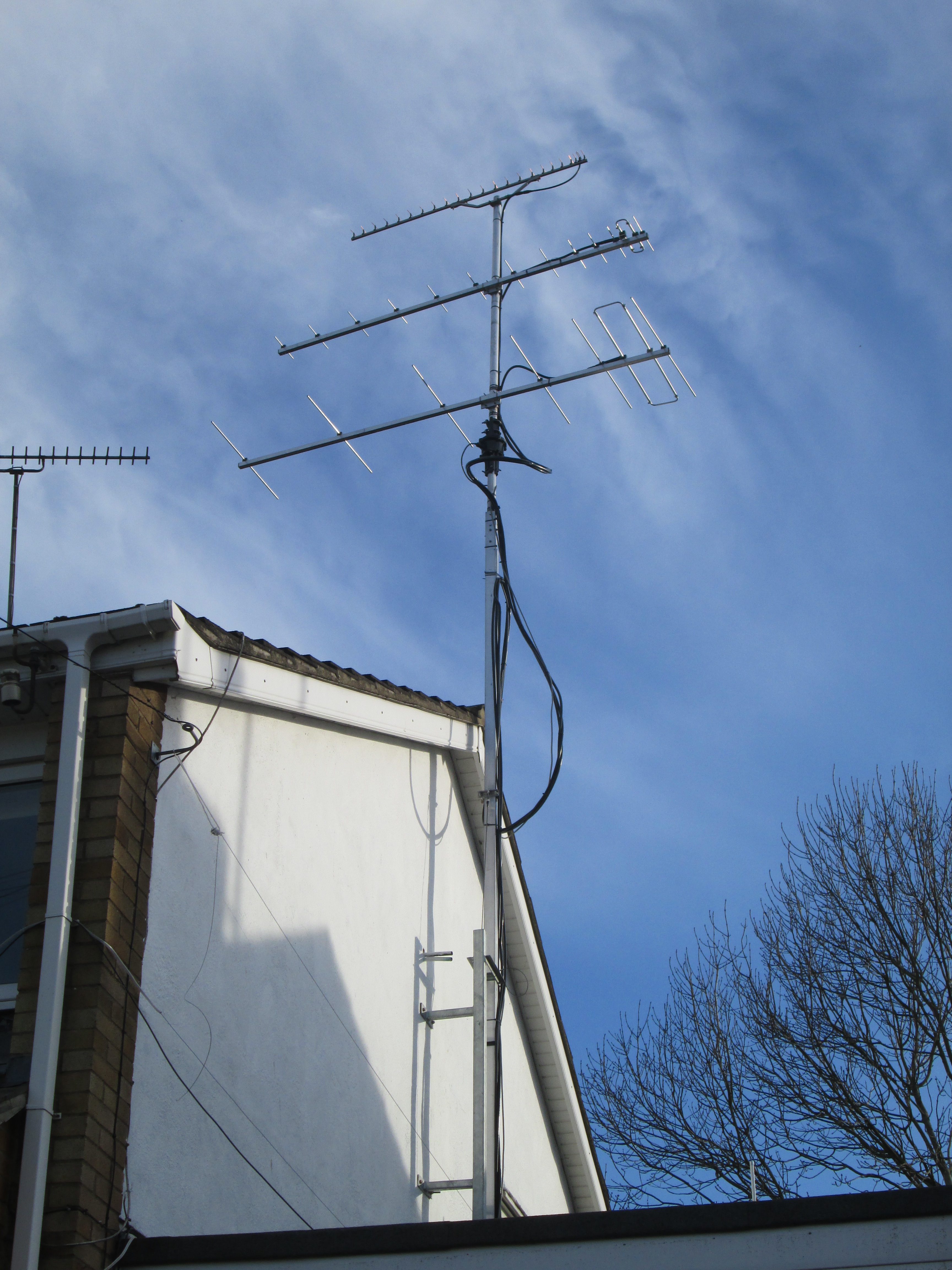
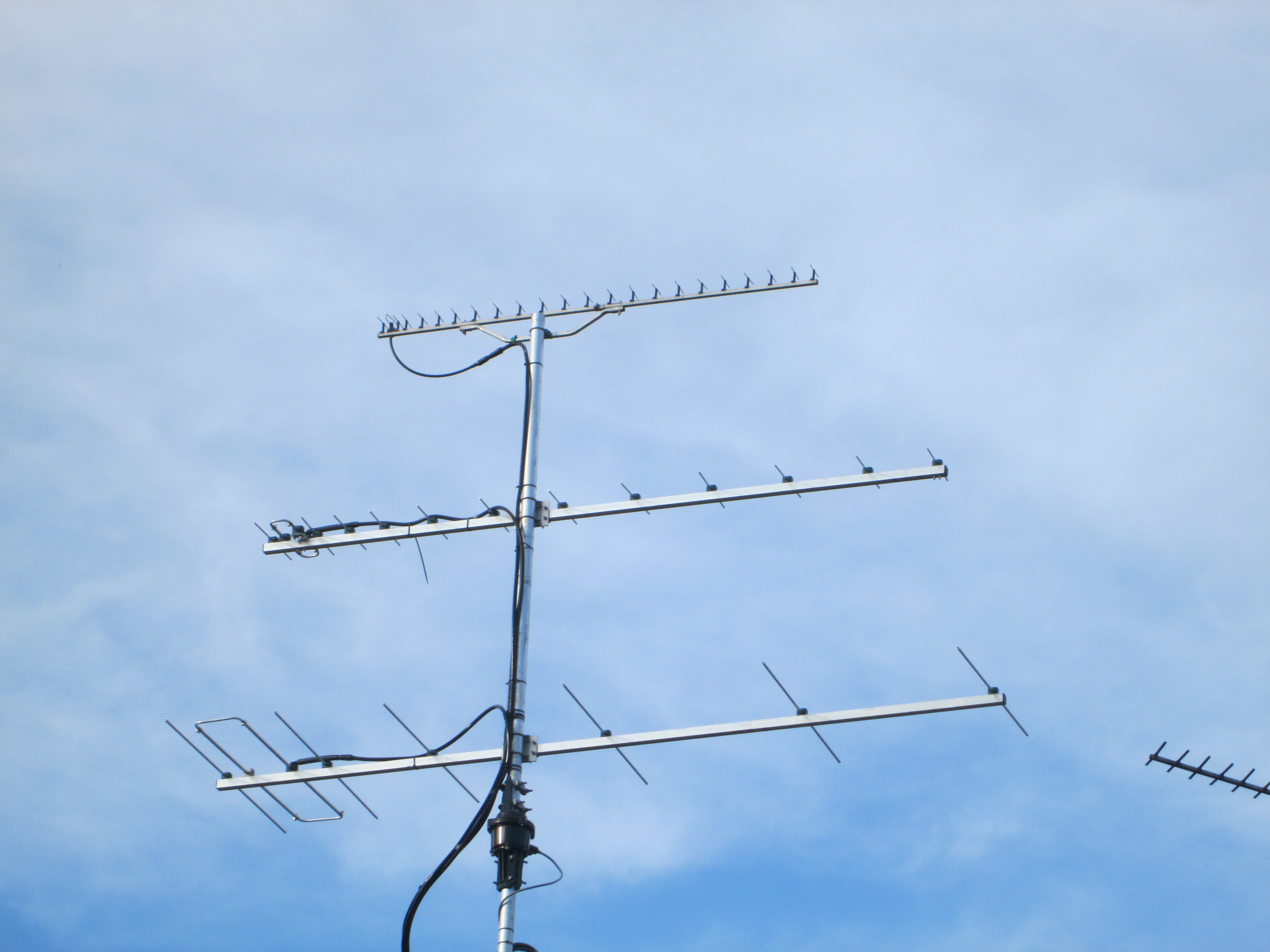
VHF antennas at G4MCU

In the last few weeks I have given my talk or presentation entitled “My VHF Journey” to two local radio clubs. This is a personal story explaining my starting out in amateur radio and how I came to enjoy mostly working VHF from my early days, and why I enjoy it now.

My primary interest is in working DX on 144MHz, 432 MHz and even 1296 MHz if conditions allow. I have quite a modest setup with regard to antennas as I do not have as much room or space for large arrays, but I do have an effective station for working VHF DX.

As a rule the club members have no idea what is available using SSB and CW on these bands. Their experience tends to be working FM simplex and repeaters on 2 and 70, and because of the licence changes new licensees have the freedom to use the HF bands, neglecting the opportunities to work any distance on the VHF bands. They are actually unaware or indeed ignorant of what they might achieve if they gave these bands a proper go with decent Yagi antennas. And no, these antennas do not have to be large. Mine aren’t.

I did my best to explain the joys of tropo, aurora and Sporadic E including the nature and the reasons these types of propagation occur.

Despite my best efforts I am not confident that my audiences understood or felt drawn to try the joys of working real radio at VHF. It is not even just about working the DX. Under flat conditions we can have quite long rag chews using SSB over distances much further than can be managed using FM.

It is not my place to tell any of my fellow radio amateurs what they should be doing, it is up to them However, after writing the presentation and speaking to the clubs I have the feeling I may failed to inspire anyone to have a go.

My Yaesu FT290R(s)

I really like this radio.

The Yaesu FT-290R is a 2 metre transceiver that has been popular among amateur radio enthusiasts since its introduction. Here’s a detailed overview of its features, specifications, and functionality:

General Overview

The Yaesu FT-290R is a portable, all-mode 2-meter transceiver designed for amateur radio use. It was first introduced in the early 1980s and has since gained a reputation for its reliability, compact size, and versatile functionality. This radio is particularly valued for its performance in SSB and CW mode, making it suitable for various communication needs, including voice and Morse.

Key Features

  1. Frequency Range: TX/RX: 144-148 MHz
  1. Modes of Operation: FM, SSB, CW
  2. Power Output: Maximum of 2.5 watts.
  1. Power Supply: Operates on C Cell batteries or an external 13.8V DC power source.
  1. Display: Digital display for frequency readout.
  1. Tuning: The radio features a main tuning dial, a fine-tuning control, and up/down buttons for frequency adjustment.
  1. Memory Channels: Provides programmable memory channels for storing frequently used frequencies.
  1. Antenna: It normally has an extendable telescopic whip on the front of the rig, which is left retracted if connecting to an external antenna via the SO239 socket on the rear. If you do not have the whip when acquiring your used FT290R these are often available on eBay.

Notable Functions

  • IF Shift: This allows the operator to shift the Intermediate Frequency (IF) to avoid interference.
  • Noise Blanker: Helps to reduce pulse noise interference, such as from car ignitions.
  • Clarifier: Fine-tunes the received frequency for better signal clarity.
  • Squelch Control: Eliminates background noise when no signal is being received.
  • Repeater Shift: Facilitates easy access to repeaters by automatically shifting the transmit frequency.

Usage and Applications

The FT-290R is versatile and suitable for a variety of applications:

  • Portable Operations: Due to its compact size and battery operation, it’s ideal for portable operations, including field day activities and emergency communications.
  • Mobile Operations: Can be used in vehicles with an external power source and mobile antenna.
  • Base Station: With the appropriate external power supply and antenna, it can serve as a home base station and it is very capable of working serious DX with a solid state amplifier and as little as 25 watts. I have had a lot of success in the past doing this.
  • Driving a transverter: I actually have three FT290Rs as they are handy for other functions apart from working on 2 metres.

Common Accessories

  • Microphone: Handheld microphone for PTT (Push-To-Talk) operations.
  • Carrying Strap: For easy portability.
  • External Speaker: Enhances audio output.
  • Antenna Tuner: Ensures the best match between the radio and the antenna.
  • DC Power Cable: For connecting to external 13.8V power sources.

Conclusion

The Yaesu FT-290R remains a popular transceiver among amateur radio operators for its robust build, reliable performance, and the flexibility of operation it offers across multiple modes. Its ease of use, combined with its portability, makes it a favoured choice for both new and experienced amateurs. Whether for casual communications, contesting, or emergency use, the FT-290R delivers dependable performance. I often have an FT290R in a canvas bag in my car. I never know when I might fire it up into my nineteen-eighties 5/8th whip.

All in all a great versatile classic rig.

Exciting news! TEP on 144 MHz.

Photo by Gratisography on Pexels.com

Yesterday EI7GL reported on TEP signals being received between Namibia and Greece (31st March 2024), details here. A distance of 6530km. That certainly spiked my interest.

Last night, 1st April 2024 I checked DX Maps as I do regularly. It is reported there that 9H1TX worked on SSB V51WW at a distance of 6092km and also subsequently had another contact using Q65 digital mode. In between, SV8PEX also worked V51WW via Q65, 6522km. Maybe 1st April but not an April Fool’s joke.

I am sure we will hear more about this soon. It is likely the distances are near the limits for 2 metres, not so different from the 4 metres TEP distance limits, and the furthest north TEP is likely to reach for these bands.

My Yaesu FT221R

As I mentioned, my Liner 2 started my interest in serious operation on the 2 metre band. The Liner 2 was of course SSB only. It did not take long for me to realise that this was my “calling” in amateur radio; it was what I wanted to do.

In 1978 I bought my Yaesu Musen FT221R. It was very expensive and cost over £400 if I remember correctly. I was fortunate in that I still lived with my parents at their home, and although I paid my keep, I did not have other overheads and therefore was able to afford it.

This new rig was a multimode with FM, CW and SSB. On the receive side the sensitivity was not great, but there was available a replacement “front end” available from muTek, a business owned by Chris Bartram G4DGU, which improved sensitivity and handling of adjacent strong signals. The FT221R had the advantage of simply slotting in a board, so the “mod” was very simple.

As sold the tuning dial was analogue only, but there was available an external digital frequency display YC221 which plugged into the back of the rig.

The new radio was very successful in working 144 MHz DX. After a while I graduated to running a 16 element Tonna and then 2 X 16 elements on my 40 feet tower. Those were the days! I had a very good VHF site in Billericay, so I had a lot of advantages, including by then a linear capable of 200 watts.

So, I worked a lot of DX. However I wanted to try meteor scatter, which was partly my incentive to pass the Morse test, which I did with the assistance of my Datong Morse tutor. Meteor scatter in those days was done by receiving 200 words a minute or 1000 letters per minute plus and slowing down to readable levels with a cassette tape recorder and suitable pot. Transmitting at this speed required an automatic keyer. Many of my friends built their own but I had a Datong keyboard keyer which did 1000 lpm just fine, and the FT221R managed to handle it well without any mods. A good system and I worked MS DX mostly down to Southern Europe, looking back at my old log now.

The old thing does work now but still needs some work. 10 watts on transmit, favourable report, receives OK on SSB and FM. It might do with a preamp, but weak beacons are audible.

Addendum: One thing I did not mention is that the rig just plugs into a mains power supply. So convenient! A separate PSU is not required though could be used with 13.8V DC if required.

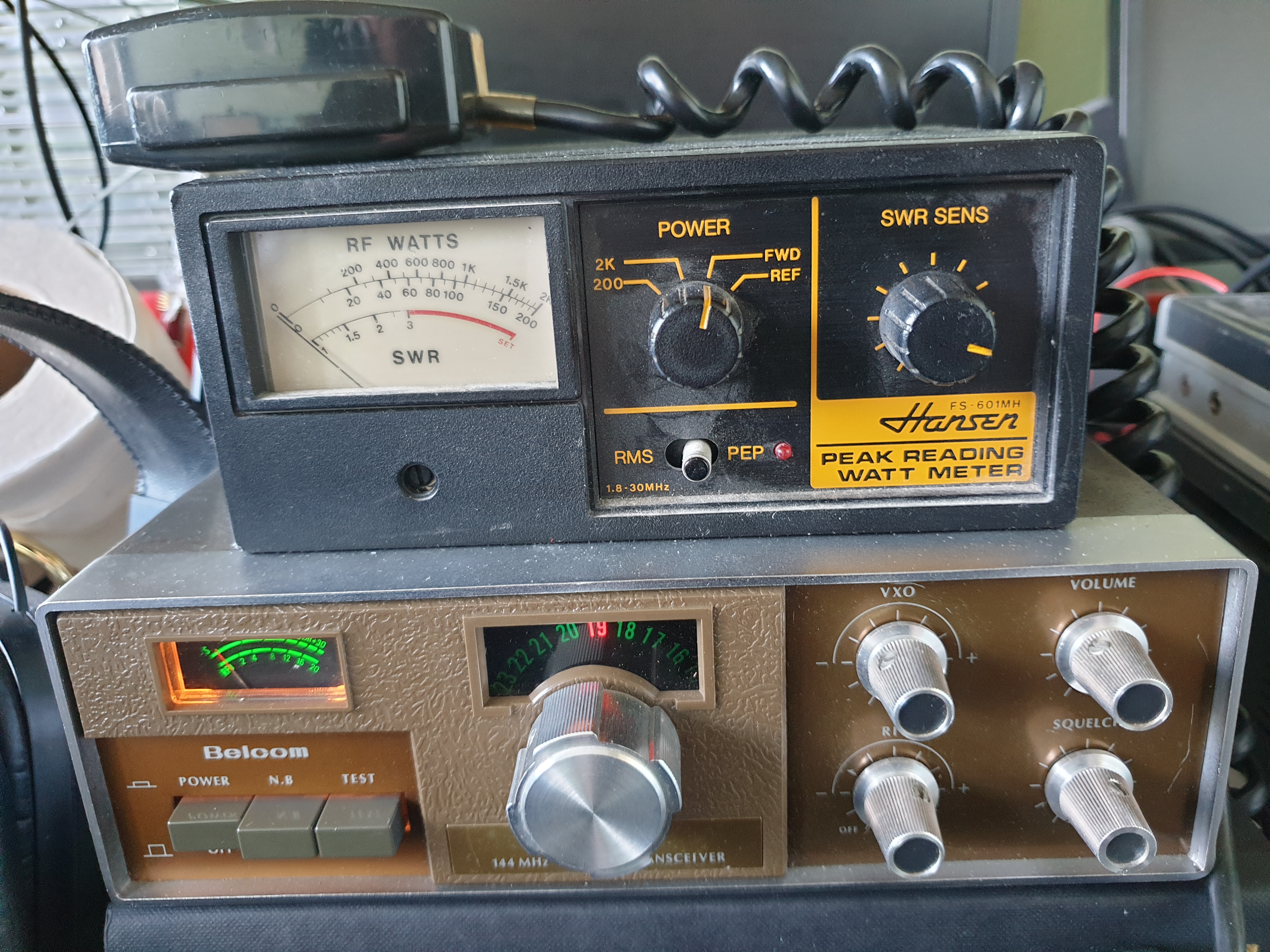
My Belcom Liner 2

I have a Liner 2, recently refurbished and it runs a nice 6-8 watts as it always did. It covers 144.100 MHz to 144.330 MHz. I bought it second-hand in 1977 as an ignorant recently licenced Class B, bored with 2 metre FM from half a dozen rocks (crystals) and one repeater. In a sense I had been mis-sold a basic 2 metres FM rig and an unsuitable horizontal yagi antenna

The very day I got the Liner 2, 22nd June 1977,  I connected it to my J-Beam 5 over 5, the first two stations I worked were an SM and an OZ. It just happened there was a decent tropo opening, though I did not realise this. This started my then and now principal interest in VHF DX. Without that I might have been a different sort of radio amateur or given up. So thanks to my Liner 2, here I am.  And of course the unsuitable yagi became just the right thing for 2 metres SSB.

The Belcom Liner 2 is a 24 channel SSB transceiver for 2 metres. It does not have a VFO but is VXO controlled (Variable-tuned Crystal Oscillators). Each channel can be tuned sufficiently with RIT so there is effectively full coverage between 144.100 and 144.330 MHz.

The rig is essentially a 27MHz CB transceiver with a form of transverter.

There have been a lot of very rude comments about the quality of signal output. Many people were keen to suggest distortion and splatter. I think mine is clean at current power output, though I will not be using an amplifier with it.

Three cheers for the Liner 2, I say.

Aurora 5th November 2023

I missed most of the aurora on 5th November, which was apparently very good visually, though it was wet and overcast in my part of Essex when I looked out. That was a pity as it would certainly be something to write home about for a visual aurora to be seen in Essex. I did catch what I think was the later part of the radio aurora when it was fading. I am terribly rusty with my CW but thanks to Peter, MM0CEZ’s patience I managed to complete with him. Thanks, Peter.

Anyway here is my meagre haul, but I believe stations far as OK were worked on 2 metres by others.

2023-11-05 17:07 GM4FVM 144.270 SSB IO85wu Scotland Jim Edgar QTF North
2023-11-05 17:15 GM4GUF 144.312 SSB IO85eo Scotland Robert West QTF North
2023-11-05 18:17 MMØCEZ 144.060 CW IO75xu Scotland PETER MORAN

I am going to get my CW back up to speed and hope for another nice aurora or some decent tropo soon.