It seems the Sporadic E season is pretty much over, and it has been a fairly poor one, as even 50 MHz enthusiasts are saying. Anyway, here is my mostly 2 metres DX summary for June and July 2023.
Sporadic E
5.6.23 HA8AR KN06
LZ2LY KN13
HA3KZ JN97
13.6.23 LZ1ZP KN22
LZ2ZY KN13
15.6.23 I7CSB JN71
IK7RWE JN80
IK7JNM JN80
IK7BZY JN61
IK8HJC JN70
LZ1RDD KN12
E73O JN95
6.6.23 Re tropo, several OZs, JO45, JO46, JO44 and a German JO54 and the two on 7th.
7.6.23 SM7EYW JO65
DK5HQ JO53
On 70 cms OV3T JO46 was a huge signal 13.6.23 in the contest and worked him on SSB of course but had to go QRT so I don’t know what else was about. All seemed gone the following morning.
A bit more Sporadic E fun in the afternoon, 9th July.
All 2 metres SSB
IZ7FLS/6 JN62
IK7EOT JN80
IZ6ZER JN63
IZ7UMS JN81
IZ7DPB JN80
It all lasted about 40 minutes here from the first at 1608z. Others may well have worked more.
I am happy with what I worked but Sporadic E has been very sporadic this summer.
I mentioned in a previous post that I had a brief chat with Dick ZS6BUN over dinner at the RSGB Convention. He talked about VHF activity in South Africa and we each have an IC-9700. QRZ.com informs us that he is interested in weak signal work at VHF. Dick touched on the subject of TEP on six metres. Of course, not everyone at the table was into VHF so it was only a brief conversation on the subject.
“For some years stations in South Africa (ZS) have had a 70MHz allocation. The 9000km path between the UK and South Africa is particularly interesting as both ends lie at the extremity of the trans-equatorial zones. A contact over this TEP path is quite possible around Sunspot maximum and should take place when conditions are particularly good on the 50MHz band. Possible openings between the UK and South Africa will probably occur during the month of October.”
I am a newcomer or at least very late returner to 4 metres; I have limited experience and 50 watts to a quarter-wave vertical. However, I am very much interested in VHF propagation and was surprised by the comment about TEP on 70 MHz as far as the UK is concerned.
I emailed Dick in South Africa to ask him if he had any knowledge about this. He replied that he worked TEP on 50 MHz but was not equipped for 70 MHz However his friend Willem ZS6WAB is active on four metres TEP and has been for quite a long time. This was useful information and set me on the trail to find out more.
It turns out that Willem has worked into Europe on 4 metres and it looks as though he is the SSB record holder for distance although there is one longer into Italy via ISCAT. So there have been TEP QSOs between South Africa and Rome and to Mallorca.
What I cannot find is any reference to 70 MHz TEP QSOs further north in Europe, and apparently not to UK.
I would welcome any additional information. It is just conceivable that UK – South Africa contacts at 70 MHz could be made via TEP and some other mode of propagation, maybe very enhanced tropo, even Sporadic E, but both SpE and TEP are seasonal (SpE around the solstices and TEP around the equinoxes) so they may not coincide. TEP is apparently via chordal hop relying on two reflections via the F layer without an intervening ground reflection. One of my correspondents has suggested that the “geometry” may not be right for contacts beyond around 7,500 km on four metres. Has that distance been exceeded? I do not know.
I passed the Morse test and obtained my Class A licence in 1981 in order to operate meteor scatter on 2 metres using a high speed keyer, which sent code at 1000 lpm or equivalent to 200 words a minute. Like many others I used a cassette tape recorder with suitable pot to slow the tape down so that I could decipher what was being sent in response from the other end. We used to set up skeds on 20 metres (14 MHz) and that was the other reason I had to pass the Morse test; to be allowed to go on any frequency below 144 MHz in the first place. Incidentally my Yaesu FT221R handled 1000 lpm well without any mods.
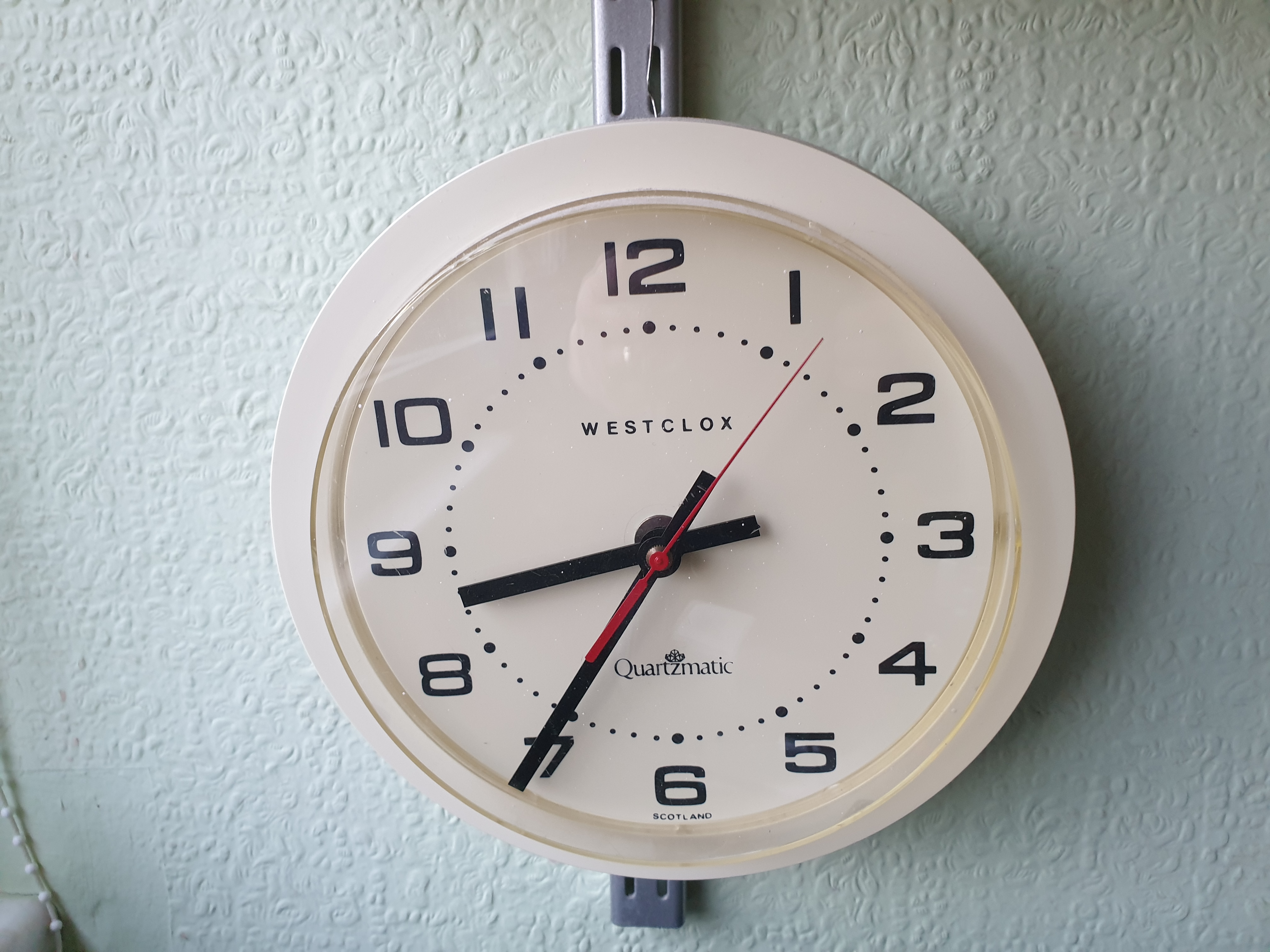
We used to alternately transmit and receive in five minute periods and for that reason needed a very accurate clock. My then shack clock is pictured. It kept very precise time to the second once set against the pips on the BBC or the speaking clock on the telephone. This clock did a few years as the shack clock, and then thirty years as the kitchen clock (because that is what it is) and now as we have a new kitchen and new kitchen clock it is back as the shack clock. It has worked faithfully all these years and still keeps very good time. It is a very good example of older technology which just worked!
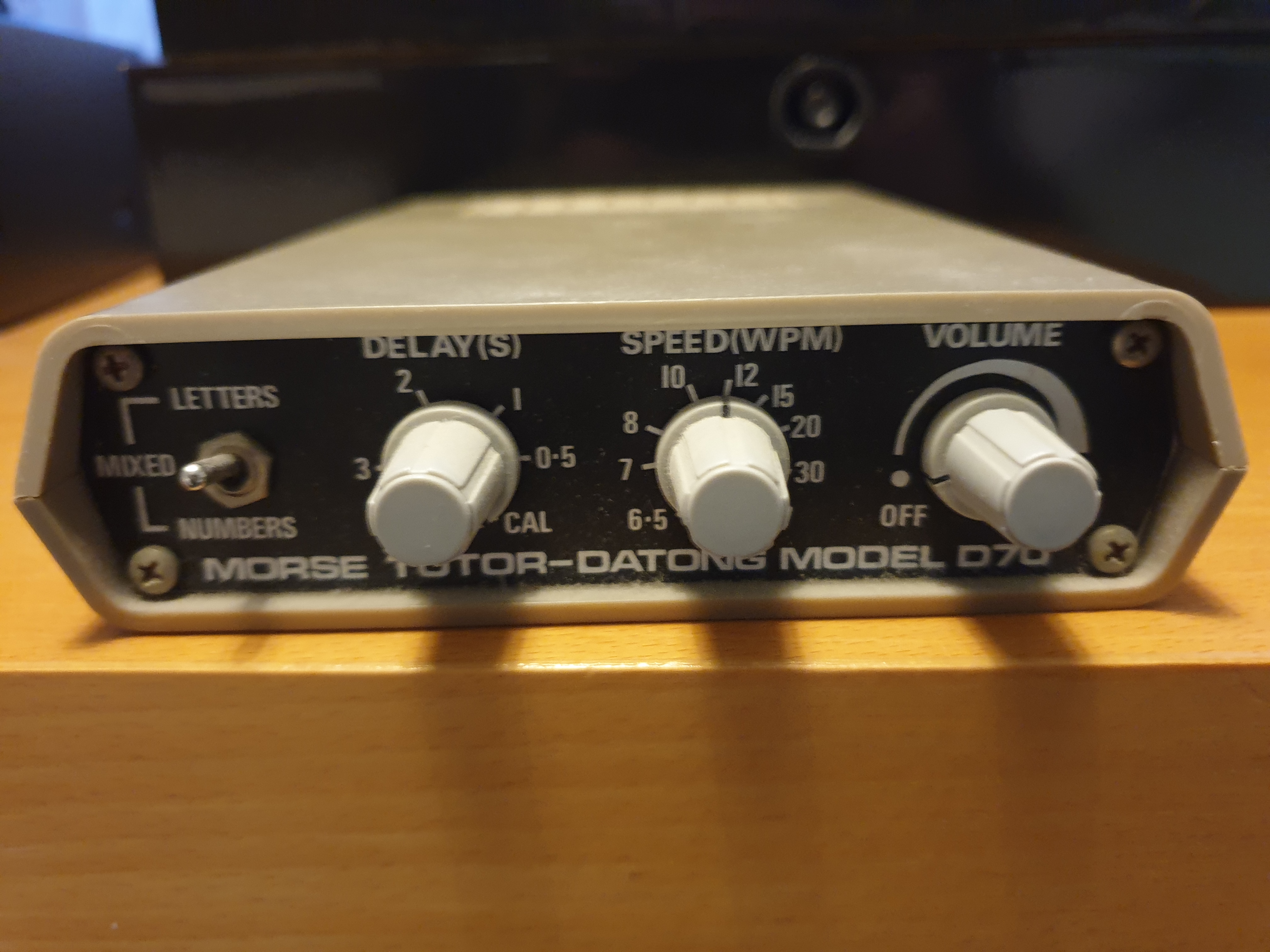
What helped me most to pass the Morse test in 1981? Well, I had my Datong Morse Tutor. I have never checked how accurate the speed calibration is, but it is supposed to be 6.5 to 37 wpm. I have no reason to doubt that, and it sounds about right, quite literally, as the Tutor still works well after at least 41 years.
I still have the FT221R but have not fired it up recently. On the subject of old technology from the Eighties my original FT290R works well but has needed repairs, and I like FT290Rs so much I have another two available for transverting, or operating on two metres in addition to my modern rigs.
But I just love the way the old clock and the Morse Tutor still work as they always did and I will be using the Tutor for practice as I return to active CW.
Kent Hills Park reception and the radio van on the air
I attended nine lectures over the two days, five on Saturday and four on Sunday. My main interest in radio is propagation, especially VHF, but I am always willing to add to my knowledge regarding the lower frequencies.
I started on Saturday with “Building a VHF/UHF contest station” with Alwyn Seeds G8DOH. Contests are not really my thing but there were some useful tips on setting up a station. In the afternoon John Regnault G4SWX presented “Using the right tools to work more 144MHz DX, which was fascinating to hear how he does it very successfully. Next on was James Stevens M0JCQ with “VHF Equipment to start you going” which would have been particularly useful for VHF beginners and is something James has written about in RadCom.
Following on was John Petters G3YPZ “Getting ready for Cycle 25 – What to expect on the HF bands” which was interesting for me as I may return to the lower frequencies. John promotes the use of AM, which may not result in the best communication, but I am sure it is fun. I have worked John often on 2 metres but never on HF.
I finished the day with Nick Totterdall G4FAL’s Transatlantic Tests, which was a history of the early years of radio from around 1920.
On Sunday morning Brian Coleman G4NNS introduced us to the UK Meteor Beacon Project which was interesting but technical. I then attended Steve Nichols G0KYA, talk on “RadCom HF predictions – now and in the future”. Yes, lower frequency stuff, but good to know they do it.
In 2019 I did not stay until the end, going home early Sunday afternoon. This year I attended two after lunch lectures as I felt they would be unmissable. The first was a fascinating talk by Dr Colin Forsyth of UCL’s Mullard Space Science Laboratory about Space Weather which is very relevant to amateur radio both for HF folk and us VHF people. It was very technical at times, but I think I got the gist.
The second talk on Sunday afternoon was entitled “What have the 2020s told us about Sporadic E?” by our old “weather friend” Jim Bacon, G3YLA. A good deal of Jim’s material was also quite technical and was remarkably interesting, but we still do not fully understand why Sporadic E propagation happens or how it can be predicted. It was very worthwhile staying for the afternoon sessions.
I thought the event was excellent, the content of the lectures was of a high standard and kept me more engaged even on subjects outside my main interests in amateur radio. I hope I learned quite a lot. I would certainly recommend to anyone who has not been to an RSGB Convention to consider attending in 2023.
Many of the lectures were livestreamed but also recorded so in due course they will be available on YouTube. Well worth watching and revisiting.
I learned yesterday that Mal Guthrie, G1NOX, Dartford, had gone Silent Key. I never met Mal in person but since my return to radio four years ago we had many contacts, and he came across as a very caring and interesting guy. I know he enjoyed dancing (jiving) and liked old cars, but we discussed so many things.
Mal had OFCOM withhold his details and you would not find him on QRZ.com, yet he was a stalwart on 2 metres SSB, calling CQ pretty much every day on 144.30 SSB. He worked us locals, and up and down the country with a decent set-up and was also on 70 cms. I know he enjoyed working serious VHF DX too, though I think he did not keep much of a log as many of us do.
There will be many people throughout most of the UK who will remember Mal, mostly for 2 metres, and he will be much missed, and certainly very much by me. RIP Mal, a really nice chap.
An exciting couple of days after my previous post about working the Spanish station on 4 metres!
Yesterday things started to happen on 144 MHz and in just over 20 minutes from 1510z I worked IK0FTA, IK0SMG, IK0RMR, and IK0BZY all in JN61, all 59. I did not hear anything else in terms of DX on the band though some other stations did. I felt pretty pleased with this “haul.”
Then, much to my surprise (again) having gone back to 70 MHz for a look just after 1800z I worked 9A2SB (JN95) and 9A1Z (JN86). My 50 watts SSB and small Moonraker vertical are doing well, far better than I hoped. I think I rather like 4 metres. I certainly did not expect this sort of DX on 4 with the antenna I have, but this is terrific! I have worked just four squares and three of them are rather distant, and 9A2SB is nearly 1,500 km away.
After a long time with no decent tropo it has been an interesting week with a good opening to Scandinavia and the Baltic. Conditions were first good on 17th September when I worked OZ on 23 cms, but on 2 metres it seemed initially that the good propagation was going over our heads on the East Coast, with the West, Wales and Northern Ireland being favoured into Scandinavia. I cannot complain too much. I did make some good QSOs as the days moved on, the highlights being on 2 metres SM4GGC at 1183 km and on 70 cms SP1MVG who called me when I was just finishing with OZ1BNN. Poland was a new country on 70 cms and obviously a new square.
I run 100 watts on 2 metres and 10 watts on 23 cms with my IC-9700, and 50 watts on 70 cms using my FT991.
Here is a summary of the most pleasing contacts, all SSB:
Conditions are often not exciting on 2 metres, but I try to maintain my SSB activity, working who I can hear and calling CQ daily. Often after calling CQ for a long time I get no response but notice frequently that my QRZ look-ups have increased by one or two while I have been calling.
So, I say to those looking me up, “why not call me rather than just checking my profile?”.
Firstly, the good news. On 25th May I worked LZ1ZP in KN22 during the afternoon. On 29th May I worked IT9YLF in JM68 and 9H1TX in JM75 (worked before in 2019). After a couple of failures with stations I then worked IZ8DSX in JN71.
On 31st May I worked IK8EVE in JN71, whom I also worked in 2019.
The big disappointment was the big opening on 29th May when I heard many stations but did not complete with most. The problem was getting through the pile ups, given that I am in JO01 which is a densely populated square hence lots of stations were hearing and calling the same people as I was. I heard UT3UX, UT9UR, UR5RQP, 9A2B and 9A2RD. Had I been logging as an SWL I would have been delighted. As it was, I ended up disappointed. Still, not working stuff I wanted is not the end of the world, is it?
We had an interesting tropo event starting on 28th December and ending at my QTH on 30th. All QSOs were SSB. Conditions were very good to the East and North East, and good to the South and South West, but surprisingly from my QTH there was less propagation to the South East, so no HB9s etc. On 2 metres I used my newish IC9700 with 100 watts to my 7 element and on 70 cms my FT991 with 50 watts to a 13 element.
On 2 metres amongst others I worked on the 28th:
F5ICN JN03 933km
F3EZJ JN05
EA1MX IN73 974km
F4CQA JN17
F0FHU JN06
On 29th:
SM7EQL JO65 940km
OZ7UV JO65
SM7NGR JO65
DL2RZ JO54
GU0UVH IN89 not so far but I had never worked Alderney!
On 30th:
EB1AH IN73 and he was running 5 watts to a 3-element antenna
On 70 cms amongst others and still all on SSB on 29th:
GJ8CEY IN89 not so far but a new country and square on 70 coms
GU6EFB IN89 new country 😊
DL1YAW JO41
DJ8MS JO54 793km
OZ9FW JO65 883km
OZ1HDF JO55 852km
OZ9GE JO66 905km
OZ8ZS JO55 851km
EI19RE IO51 New country and square on 70 cms
Conditions were so good for a period that the OZs called me on the back of the beam as I was looking South West.
I know that others worked more DX than did I, but I enjoyed the event and am happy with the results.




 Conditions are often not exciting on 2 metres, but I try to maintain my SSB activity, working who I can hear and calling CQ daily. Often after calling CQ for a long time I get no response but notice frequently that my QRZ look-ups have increased by one or two while I have been calling.
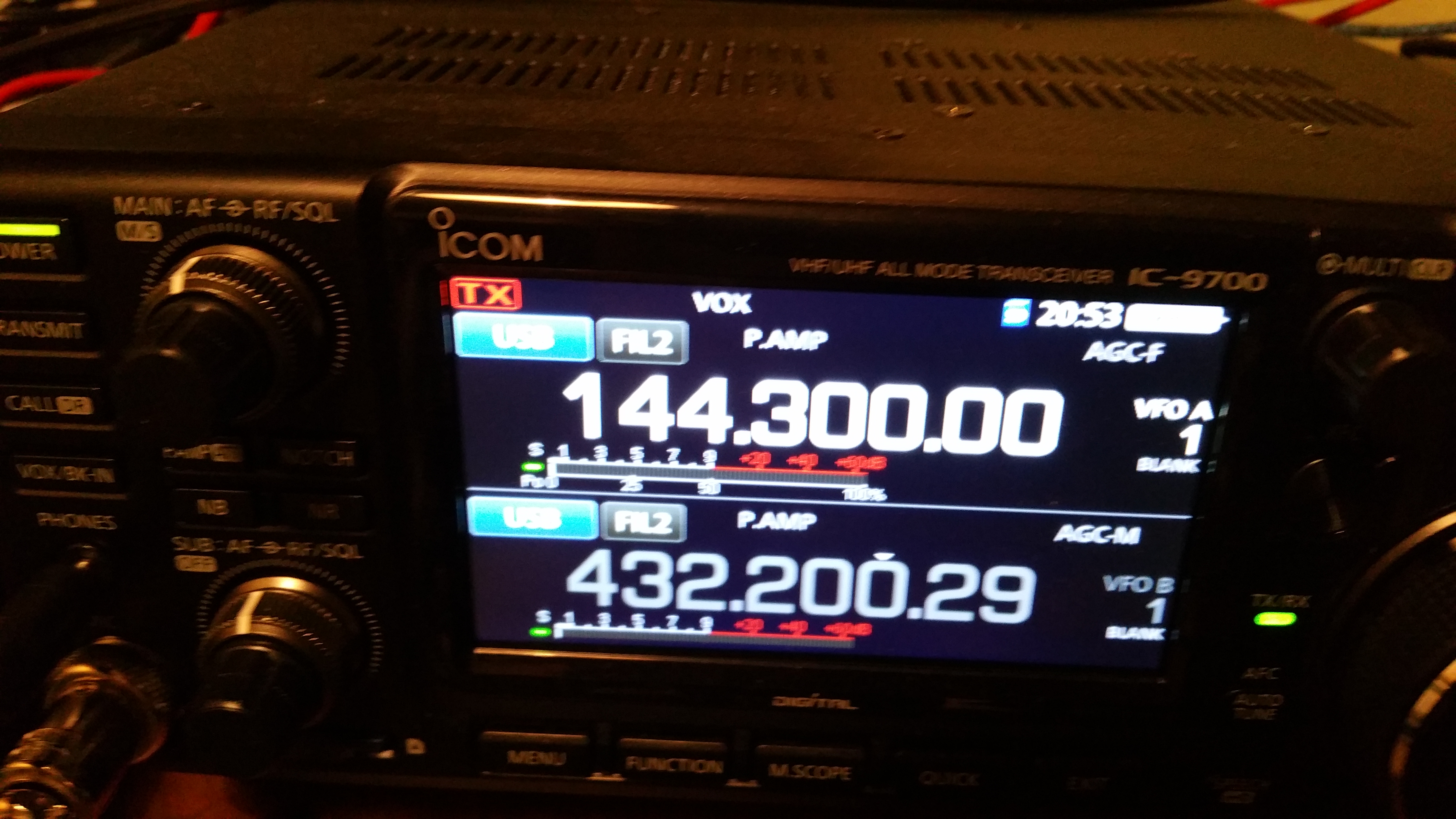 We had an interesting tropo event starting on 28th December and ending at my QTH on 30th. All QSOs were SSB. Conditions were very good to the East and North East, and good to the South and South West, but surprisingly from my QTH there was less propagation to the South East, so no HB9s etc. On 2 metres I used my newish IC9700 with 100 watts to my 7 element and on 70 cms my FT991 with 50 watts to a 13 element.
 Amateur Radio News from Jon Stow, G4MCU