Tag Archives: SSB

My Yaesu FT290R(s)

I really like this radio.

The Yaesu FT-290R is a 2 metre transceiver that has been popular among amateur radio enthusiasts since its introduction. Here’s a detailed overview of its features, specifications, and functionality:

General Overview

The Yaesu FT-290R is a portable, all-mode 2-meter transceiver designed for amateur radio use. It was first introduced in the early 1980s and has since gained a reputation for its reliability, compact size, and versatile functionality. This radio is particularly valued for its performance in SSB and CW mode, making it suitable for various communication needs, including voice and Morse.

Key Features

  1. Frequency Range: TX/RX: 144-148 MHz
  1. Modes of Operation: FM, SSB, CW
  2. Power Output: Maximum of 2.5 watts.
  1. Power Supply: Operates on C Cell batteries or an external 13.8V DC power source.
  1. Display: Digital display for frequency readout.
  1. Tuning: The radio features a main tuning dial, a fine-tuning control, and up/down buttons for frequency adjustment.
  1. Memory Channels: Provides programmable memory channels for storing frequently used frequencies.
  1. Antenna: It normally has an extendable telescopic whip on the front of the rig, which is left retracted if connecting to an external antenna via the SO239 socket on the rear. If you do not have the whip when acquiring your used FT290R these are often available on eBay.

Notable Functions

  • IF Shift: This allows the operator to shift the Intermediate Frequency (IF) to avoid interference.
  • Noise Blanker: Helps to reduce pulse noise interference, such as from car ignitions.
  • Clarifier: Fine-tunes the received frequency for better signal clarity.
  • Squelch Control: Eliminates background noise when no signal is being received.
  • Repeater Shift: Facilitates easy access to repeaters by automatically shifting the transmit frequency.

Usage and Applications

The FT-290R is versatile and suitable for a variety of applications:

  • Portable Operations: Due to its compact size and battery operation, it’s ideal for portable operations, including field day activities and emergency communications.
  • Mobile Operations: Can be used in vehicles with an external power source and mobile antenna.
  • Base Station: With the appropriate external power supply and antenna, it can serve as a home base station and it is very capable of working serious DX with a solid state amplifier and as little as 25 watts. I have had a lot of success in the past doing this.
  • Driving a transverter: I actually have three FT290Rs as they are handy for other functions apart from working on 2 metres.

Common Accessories

  • Microphone: Handheld microphone for PTT (Push-To-Talk) operations.
  • Carrying Strap: For easy portability.
  • External Speaker: Enhances audio output.
  • Antenna Tuner: Ensures the best match between the radio and the antenna.
  • DC Power Cable: For connecting to external 13.8V power sources.

Conclusion

The Yaesu FT-290R remains a popular transceiver among amateur radio operators for its robust build, reliable performance, and the flexibility of operation it offers across multiple modes. Its ease of use, combined with its portability, makes it a favoured choice for both new and experienced amateurs. Whether for casual communications, contesting, or emergency use, the FT-290R delivers dependable performance. I often have an FT290R in a canvas bag in my car. I never know when I might fire it up into my nineteen-eighties 5/8th whip.

All in all a great versatile classic rig.

My Yaesu FT221R

As I mentioned, my Liner 2 started my interest in serious operation on the 2 metre band. The Liner 2 was of course SSB only. It did not take long for me to realise that this was my “calling” in amateur radio; it was what I wanted to do.

In 1978 I bought my Yaesu Musen FT221R. It was very expensive and cost over £400 if I remember correctly. I was fortunate in that I still lived with my parents at their home, and although I paid my keep, I did not have other overheads and therefore was able to afford it.

This new rig was a multimode with FM, CW and SSB. On the receive side the sensitivity was not great, but there was available a replacement “front end” available from muTek, a business owned by Chris Bartram G4DGU, which improved sensitivity and handling of adjacent strong signals. The FT221R had the advantage of simply slotting in a board, so the “mod” was very simple.

As sold the tuning dial was analogue only, but there was available an external digital frequency display YC221 which plugged into the back of the rig.

The new radio was very successful in working 144 MHz DX. After a while I graduated to running a 16 element Tonna and then 2 X 16 elements on my 40 feet tower. Those were the days! I had a very good VHF site in Billericay, so I had a lot of advantages, including by then a linear capable of 200 watts.

So, I worked a lot of DX. However I wanted to try meteor scatter, which was partly my incentive to pass the Morse test, which I did with the assistance of my Datong Morse tutor. Meteor scatter in those days was done by receiving 200 words a minute or 1000 letters per minute plus and slowing down to readable levels with a cassette tape recorder and suitable pot. Transmitting at this speed required an automatic keyer. Many of my friends built their own but I had a Datong keyboard keyer which did 1000 lpm just fine, and the FT221R managed to handle it well without any mods. A good system and I worked MS DX mostly down to Southern Europe, looking back at my old log now.

The old thing does work now but still needs some work. 10 watts on transmit, favourable report, receives OK on SSB and FM. It might do with a preamp, but weak beacons are audible.

Addendum: One thing I did not mention is that the rig just plugs into a mains power supply. So convenient! A separate PSU is not required though could be used with 13.8V DC if required.

G1NOX – SK

I learned yesterday that Mal Guthrie, G1NOX, Dartford, had gone Silent Key. I never met Mal in person but since my return to radio four years ago we had many contacts, and he came across as a very caring and interesting guy. I know he enjoyed dancing (jiving) and liked old cars, but we discussed so many things.

Mal had OFCOM withhold his details and you would not find him on QRZ.com, yet he was a stalwart on 2 metres SSB, calling CQ pretty much every day on 144.30 SSB. He worked us locals, and up and down the country with a decent set-up and was also on 70 cms. I know he enjoyed working serious VHF DX too, though I think he did not keep much of a log as many of us do.

There will be many people throughout most of the UK who will remember Mal, mostly for 2 metres, and he will be much missed, and certainly very much by me. RIP Mal, a really nice chap.

23 centimetres with the IC-9700

Since February this year I have added 1296 MHz to my repertoire. I have the 10 watts from the 9700 and my old 23 element Tonna which I used back in Billericay thirty plus years ago when I lived with my parents. That was prior to going QRT for those three decades, but the antenna has been perfectly preserved in the garage.

I started by working at a distance of about 150 miles G8JVM in Shropshire having started on 2 metres. Since then I have managed to work a good few in the UKAC monthly Tuesday night contests and in addition PH0V at 307 km which is 192 miles when conditions were quite good. I also have worked since PG3T at 272 km, 170 miles. I added another country with F4HRD, although Jeff is only 70 miles away.

I have also worked PE1EWR at 202 km a couple of times and PE1JPD at 321 km.

There has not been a really good opening such as I remember from the Eighties, but overall, I am pleased with the progress so far.

Activity on 2 metres, calling CQ and QRZ.com

Conditions are often not exciting on 2 metres, but I try to maintain my SSB activity, working who I can hear and calling CQ daily. Often after calling CQ for a long time I get no response but notice frequently that my QRZ look-ups have increased by one or two while I have been calling.
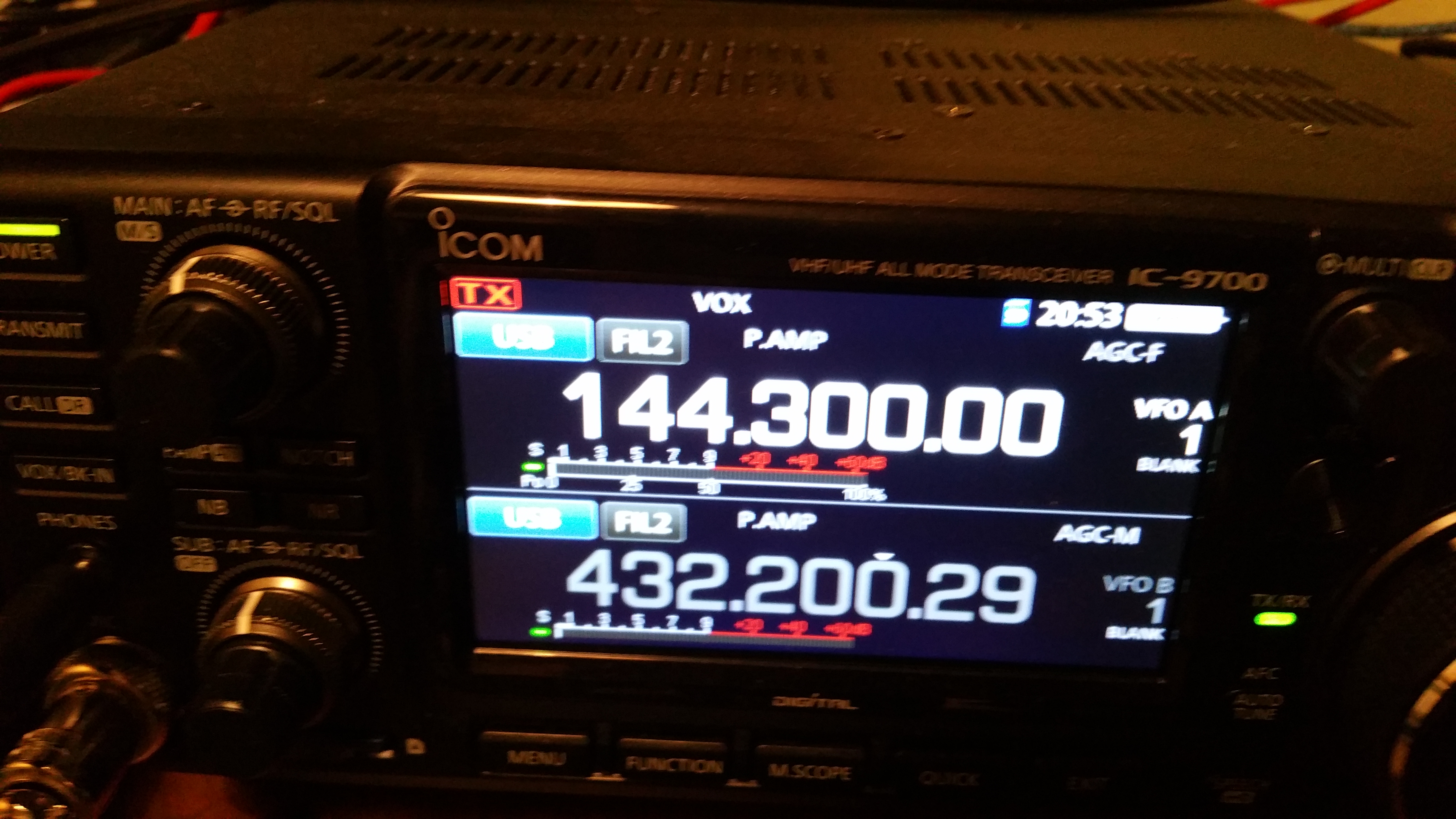
So, I say to those looking me up, “why not call me rather than just checking my profile?”.

Tropo opening 28th to 30th December 2019

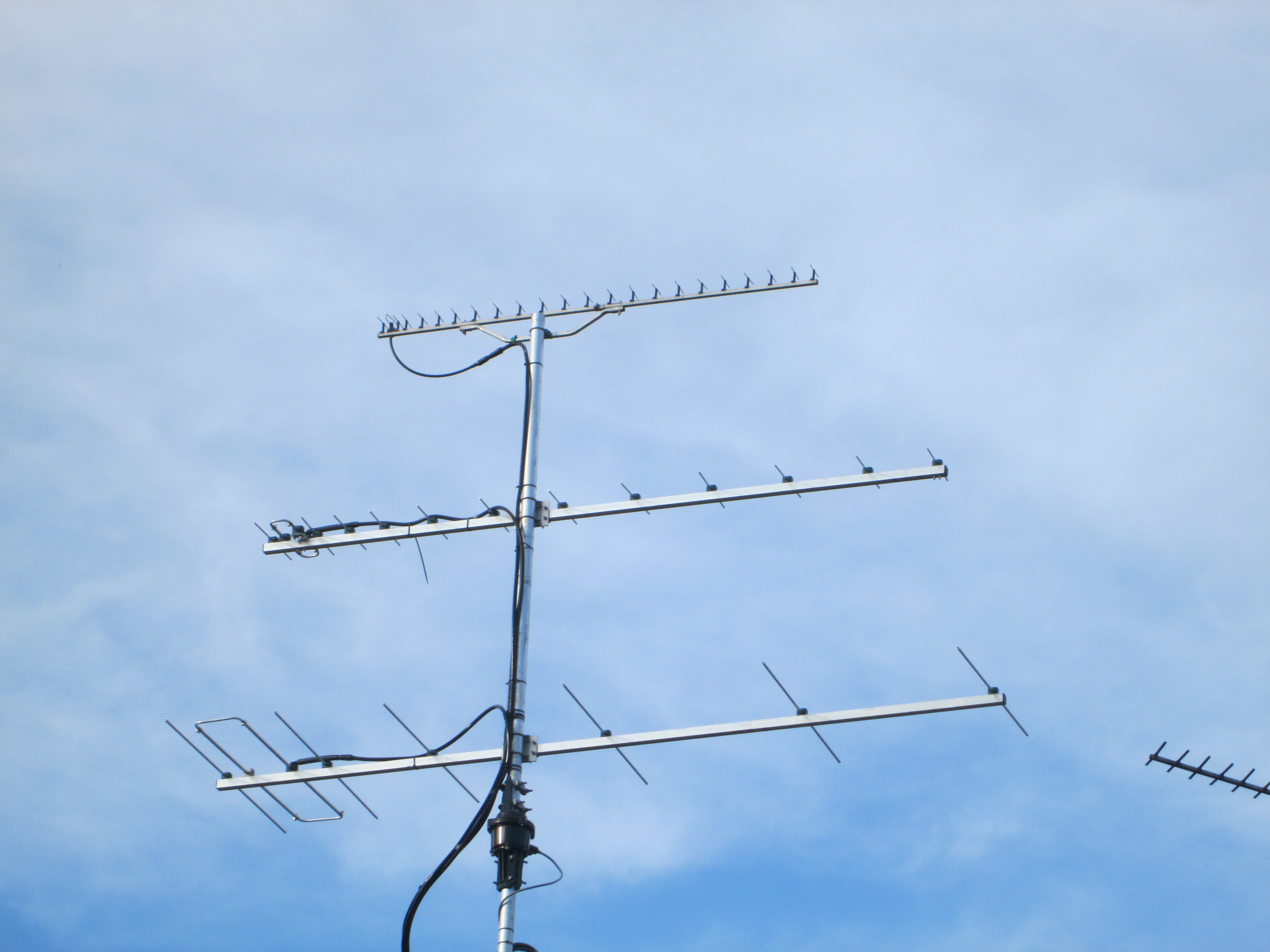
20200104_205110We had an interesting tropo event starting on 28th December and ending at my QTH on 30th. All QSOs were SSB. Conditions were very good to the East and North East, and good to the South and South West, but surprisingly from my QTH there was less propagation to the South East, so no HB9s etc. On 2 metres I used my newish IC9700 with 100 watts to my 7 element and on 70 cms my FT991 with 50 watts to a 13 element.
On 2 metres amongst others I worked on the 28th:

F5ICN    JN03    933km

F3EZJ     JN05

EA1MX  IN73   974km

F4CQA   JN17

F0FHU    JN06

On 29th:

SM7EQL   JO65  940km

OZ7UV      JO65

SM7NGR   JO65

DL2RZ        JO54

GU0UVH    IN89 not so far but I had never worked Alderney!

On 30th:

EB1AH    IN73 and he was running 5 watts to a 3-element antenna

On 70 cms amongst others and still all on SSB on 29th:

GJ8CEY   IN89  not so far but a new country and square on 70 coms

GU6EFB  IN89  new country 😊

DL1YAW  JO41

DJ8MS    JO54   793km

OZ9FW   JO65   883km

OZ1HDF   JO55   852km

OZ9GE      JO66   905km

OZ8ZS     JO55   851km

EI19RE    IO51  New country and square on 70 cms

Conditions were so good for a period that the OZs called me on the back of the beam as I was looking South West.

I know that others worked more DX than did I, but I enjoyed the event and am happy with the results.

2 metre tropo on 14th and 15th September

20190916_215503We had an interesting opening over the evening of 14th and the following morning. It started with a couple of very strong French stations in JN18. I then found the following all worked on SSB on 14th:

DL2GWZ/P   JN49

OE5XBL   JN68, 700m asl, 988 km

DF6MH/P  JN57 2400m asl, 902km

DJ6AG   JO51

On the morning of 15th when there was a contest in Central Europe:

OM3RM   JN88  1263 km!

OE3REC   JN77  1147 km

OK1DOL   JN69   906 km

F5LEN/P   JN38

OE/OK5SE/P   JN77  1137 km

OK1KKI   JN79   1059 km

Plus, some more local Continentals.

My return to 2 metres SSB after 30 years absence was only in February 2018, so OE, OK and OM are new countries on the band for me from this QTH. The Slovak Republic was a particular surprise, being so strong and my thinking he was Belgian until he gave his locator. It was early and I was still half asleep; at least that is my excuse.

The above was my first DX foray with my FT991 running 50 watts rather than the 25 watts from my old FT290R and small amplifier, but I am not mothballing the old radio and will keep it ready to go.

Lack of activity on 2 metres SSB

IMG_1249We all know there is a lack of activity on 2 metres SSB (and I guess CW), and we have the same problem on 70 centimetres. However, the main thrust I want to make is about 144 MHz

I have quite an effective station on 2 metres. It is true I only run about 25 watts to a 7 element yagi currently, but I have quite a good VHF location for Essex at 68m asl and I reckon under flat conditions I can work up to 200 miles, so more than 300 km under flat conditions. I can reach the Scottish borders or well into Germany.

However, I often call CQ for quite a while without anyone coming back. I know from talking to other regulars they have the same problem, yet I know there is no lack of well-equipped stations who could come on and make life more interesting. One only has to be QRV on the first Tuesday evening of each month when the UKAC is on to hear dozens of stations calling “CQ contest” from up and down the country. Then again, as soon as there are decent tropo conditions and openings, there is more activity. Also, there are the “big guns” who come out for Sporadic E openings.

Part of the pleasure of amateur radio is just talking about radio, comparing notes, discussing the merits of various rigs and antennas, and talking about conditions. I really do not understand what fellow amateurs get out of just lurking, waiting for an opening and not talking to the rest of us.

Come on, everybody, get more active and enjoy talking to the rest of us. Share your knowledge and expertise and let us have the pleasure of making your acquaintance.