Tag Archives: propagation

Solar activity as it effects radio propagation

Photo courtesy of Pexels-Pixabay, with thanks.

I first became interested in the Sun’s activity way back before I obtained my amateur radio licence, so that was over fifty years ago. Any errors here are of course mine.

Solar and sun-related activity plays a critical role in HF and to a lesser extent VHF propagation for amateur radio. Here’s a structured overview of how solar phenomena affect HF and VHF Key Solar Phenomena.

1. Solar Flux (SFI)

  • Measures solar radiation at 10.7 cm (2800 MHz).
  • Higher SFI = better ionisation of the F2 layer, improving HF propagation.
  • Typical values:
    • Below 70 = poor HF conditions
    • 100–150 = good for 20–10m
    • Above 150 = potential for 6m (50 MHz) F2 openings

2. Sunspots

  • Magnetic storms on the Sun’s surface.
  • More sunspots mean increased UV and X-ray output, which enhances the ionosphere.
  • 11-year solar cycle: more sunspots at solar maximum, better HF propagation.

3. Solar Flares

  • Sudden bursts of radiation (X-rays, UV).
  • Can cause Shortwave Fadeouts (SWF), especially on the dayside of Earth.
  • More likely to disrupt HF than VHF.

4. Coronal Mass Ejections (CMEs)

  • Massive bursts of solar plasma and magnetic fields.
  • Can disturb Earth’s magnetosphere and trigger geomagnetic storms (see K-index below).

Effects on HF Propagation (3–30 MHz)

Positive Effects:

  • High SFI and sunspot numbers = better F2 layer ionisation
  • Good for long-distance DX on 20, 17, 15, 12, and 10 metres
  • At solar peak, even 6m (50 MHz) can open via F2

Negative Effects:

  • Solar flares = sudden HF blackouts (especially below 10 MHz)
  • CMEs and geomagnetic storms = disrupted F2 layer, poor signal paths
  • Low solar activity = limited DX, higher bands go “dead”

Effects on VHF Propagation (30–300 MHz)

Direct effects are limited, but:

  • 50 MHz (6m): most influenced, can experience F2 openings during high solar activity
  • 70 MHz (4m): some F2 impact, mostly Sporadic-E related
  • 144 MHz (2m) and up: rarely affected directly, but indirect effects occur (e.g., auroral propagation during geomagnetic storms)

Ionospheric Layers Summary

LayerAffected byRole in PropagationFrequencies
DSolar flares, daytime sunAbsorbs lower HF (esp. 160–40m)Negative impact
ESolar UV, seasonalSupports short-skip & Sporadic-EHF & low VHF
F1/F2Solar flux, sunspotsMain long-haul DX layerHF and 6m during high sola


Useful Indices and Tools

IndexMeaningIdeal for DX
SFI (Solar Flux Index)70–300+>100 for good HF
K-indexGeomagnetic activity (0–9)0–3
A-index24h average of K-index<15
X-ray FluxReal-time flare impactLow or stable is best
Auroral Index (AU, AL)Indicates aurora potentialHigh = aurora on 6m/2m

Propagation Enhancements from Solar Activity

BandEffect from Solar MaxNotes
160m–80mPoorer day conditions (D-layer)Better at night
40m–20mStable, reliable DXDay and night paths improve
15m–10mGreatly improved10m often wide open
6m (50 MHz)F2 possibleTrue DX (e.g. EU to SA, JA)
2m (144 MHz)Aurora, rare F2Usually tropo or aurora paths

Resources for Monitoring

At the time of writing in July 2025, one can say that in the last few months and year there has been more auroral activity but rather less in the way of Sporadic E, which is what one might expect at or near the peak of the solar cycle.
Tropospheric propagation at VHF

I have tried hard to get interest in VHF working through my talks at local radio clubs but without much success. Here is a little information for a wider audience.

Tropospheric propagation is a key mode of signal transmission in the VHF (Very High Frequency) and UHF (Ultra High Frequency) bands, particularly between 70 MHz (4-meter band) and 1296 MHz (1.2 GHz, or 23 cm band). Here’s a detailed overview tailored to these frequencies:


Tropospheric Propagation Basics

Tropospheric propagation refers to the bending (refraction), reflection, or ducting of radio waves in the lowest layer of Earth’s atmosphere — the troposphere (up to ~10-15 km altitude). Variations in temperature, pressure, and humidity create refractive index gradients that affect radio signals.


1. Tropospheric Refraction

  • Always present, but often weak.
  • Causes signals to bend slightly, extending line-of-sight range (~15–30% more).
  • Most noticeable in the lower VHF (e.g., 70 MHz) and UHF bands.

2. Tropospheric Ducting

  • Occurs under temperature inversions where warm air overlays cooler air.
  • Creates a “duct” that traps radio waves, enabling them to travel hundreds to over 1000 km.
  • Most common during high-pressure systems, especially over water or flat terrain.
  • Strongest on UHF bands (432 MHz and above), but noticeable at 144 MHz as well.
  • Can support 70 MHz contacts too, but less common due to the wavelength being more sensitive to terrain and atmospheric scattering.

3. Tropospheric Scattering

  • Weak propagation mode allowing signals to travel 100–500 km.
  • Caused by small-scale irregularities in the troposphere.
  • Common across all these bands, but requires high power and gain (especially above 432 MHz).
  • Used for beyond-line-of-sight links in commercial and military systems.

Frequency Dependence Overview

Frequency BandTroposcatterRefraction GainDucting PotentialNotes
70 MHzModerateGoodRare/WeakSimilar to HF/VHF hybrid behaviour
144 MHzGoodGoodOccasionalTropospheric openings can span hundreds of km
432 MHzVery GoodModerateFrequentStrong ducting over oceans or flat land
1.2 GHzExcellentLowerStrong/SharpSharp signal peaks, strong ducting but more line-of-sight dependence

Practical Implications for Radio Amateurs

  • DXing on 144 MHz and above often depends on tropospheric ducting — watch for high-pressure systems, especially over the sea.
  • Beacons and APRS networks are useful to monitor tropo openings.
  • Weather tools (like Hepburn maps or radiosonde data) can predict ducting potential.
  • Higher frequencies (e.g., 1.2 GHz) may experience “knife-edge” sharpness in ducting — strong signals or none at all.

🛰️ Tools for Monitoring & Forecasting


If you’re using modes like FT8, SSB, or CW, tropo can extend your range significantly. Narrowband digital modes are especially useful during marginal tropo conditions at 432 MHz and 1.2 GHz.

It is a common myth that VHF propagation is line of sight, but even under “flat” conditions this is simply not so. 400 km range is often possible given suitable power and antenna. Have a go if you haven’t, starting with 2 metres, SSB or CW!

My VHF Journey

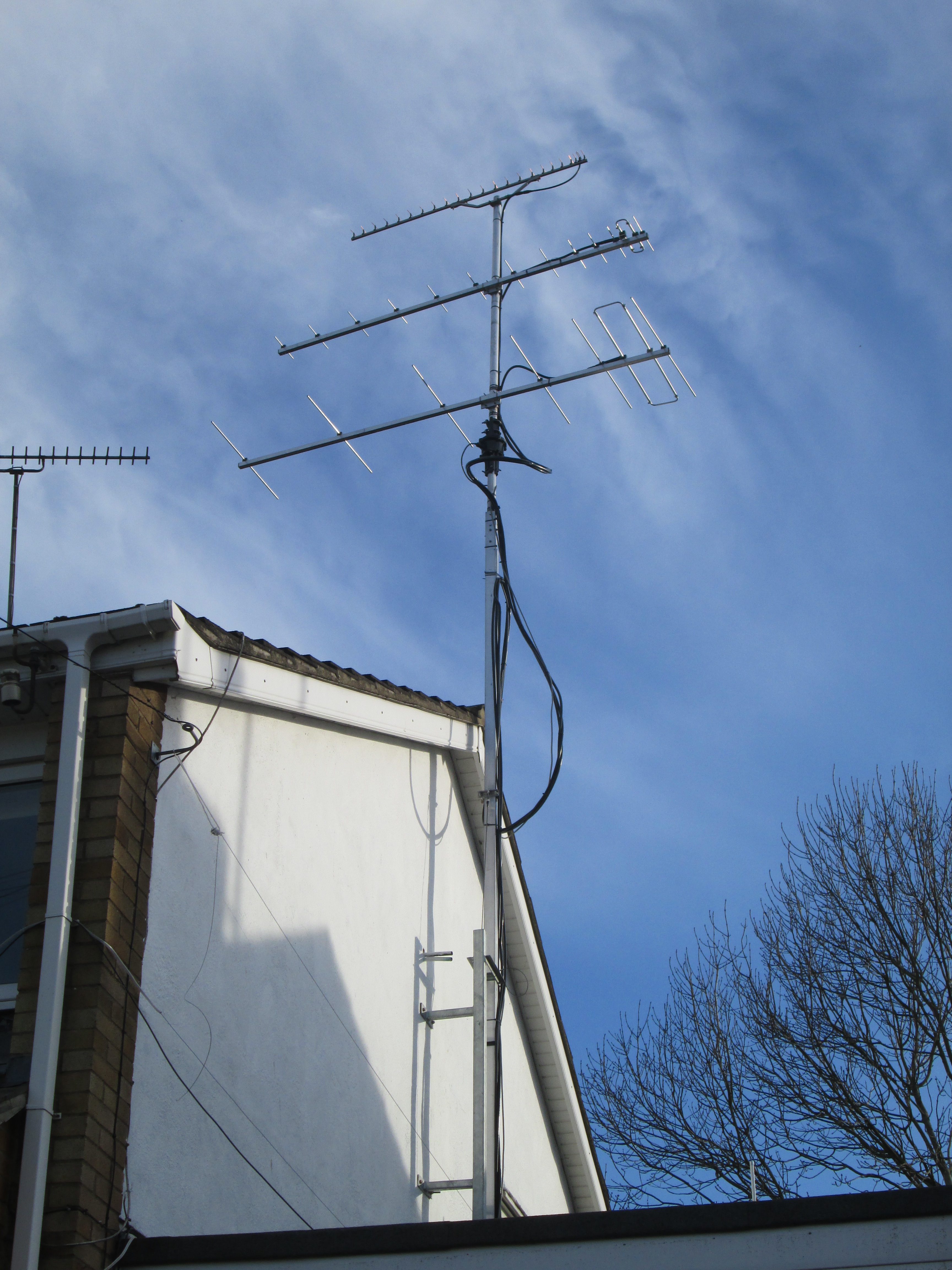
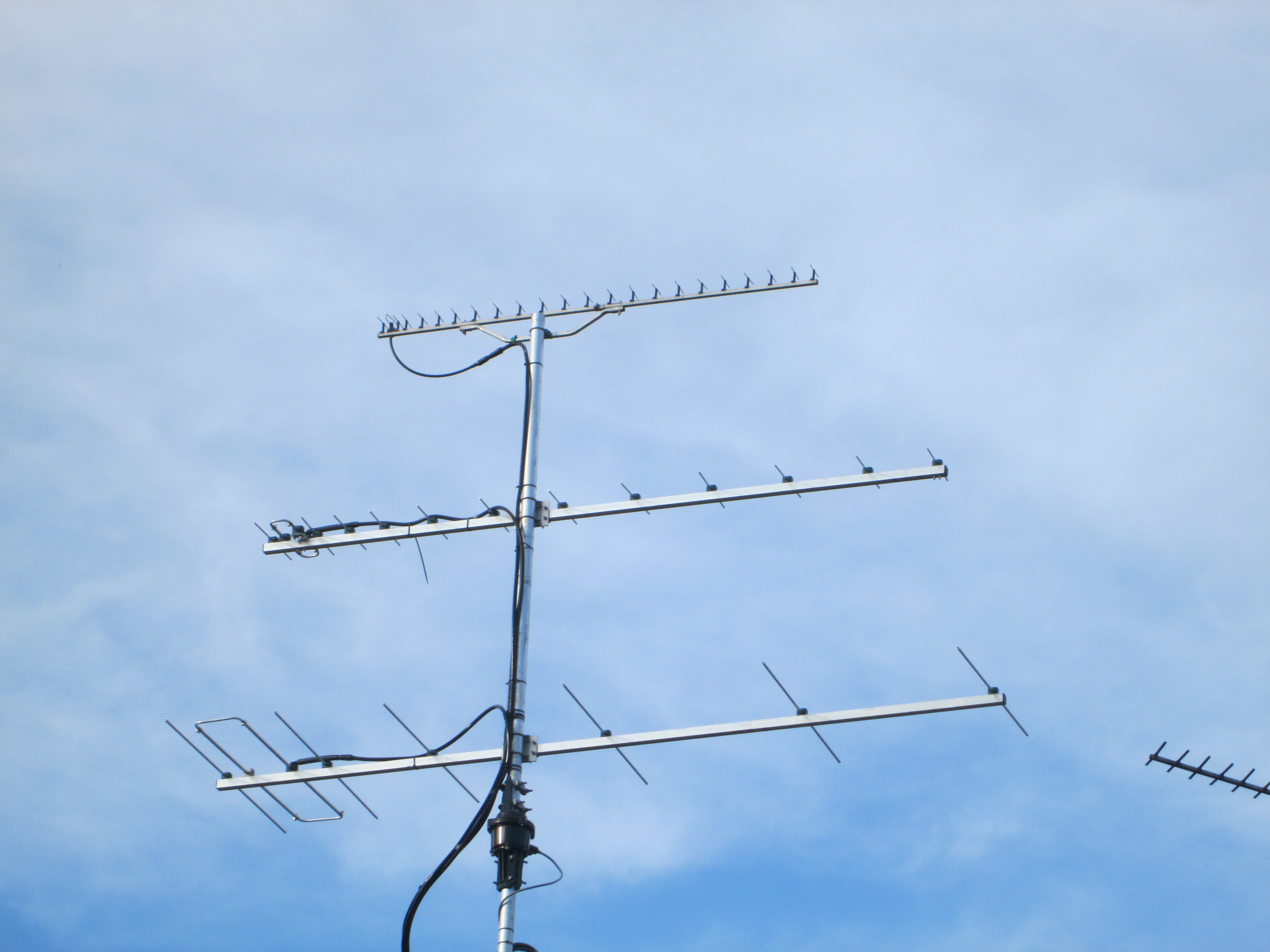
VHF antennas at G4MCU

In the last few weeks I have given my talk or presentation entitled “My VHF Journey” to two local radio clubs. This is a personal story explaining my starting out in amateur radio and how I came to enjoy mostly working VHF from my early days, and why I enjoy it now.

My primary interest is in working DX on 144MHz, 432 MHz and even 1296 MHz if conditions allow. I have quite a modest setup with regard to antennas as I do not have as much room or space for large arrays, but I do have an effective station for working VHF DX.

As a rule the club members have no idea what is available using SSB and CW on these bands. Their experience tends to be working FM simplex and repeaters on 2 and 70, and because of the licence changes new licensees have the freedom to use the HF bands, neglecting the opportunities to work any distance on the VHF bands. They are actually unaware or indeed ignorant of what they might achieve if they gave these bands a proper go with decent Yagi antennas. And no, these antennas do not have to be large. Mine aren’t.

I did my best to explain the joys of tropo, aurora and Sporadic E including the nature and the reasons these types of propagation occur.

Despite my best efforts I am not confident that my audiences understood or felt drawn to try the joys of working real radio at VHF. It is not even just about working the DX. Under flat conditions we can have quite long rag chews using SSB over distances much further than can be managed using FM.

It is not my place to tell any of my fellow radio amateurs what they should be doing, it is up to them However, after writing the presentation and speaking to the clubs I have the feeling I may failed to inspire anyone to have a go.

Aurora 5th November 2023

I missed most of the aurora on 5th November, which was apparently very good visually, though it was wet and overcast in my part of Essex when I looked out. That was a pity as it would certainly be something to write home about for a visual aurora to be seen in Essex. I did catch what I think was the later part of the radio aurora when it was fading. I am terribly rusty with my CW but thanks to Peter, MM0CEZ’s patience I managed to complete with him. Thanks, Peter.

Anyway here is my meagre haul, but I believe stations far as OK were worked on 2 metres by others.

2023-11-05 17:07 GM4FVM 144.270 SSB IO85wu Scotland Jim Edgar QTF North
2023-11-05 17:15 GM4GUF 144.312 SSB IO85eo Scotland Robert West QTF North
2023-11-05 18:17 MMØCEZ 144.060 CW IO75xu Scotland PETER MORAN

I am going to get my CW back up to speed and hope for another nice aurora or some decent tropo soon.

Tropo opening 7th – 8th October 2023

After such a long and barren period for tropo we were taken by surprise by the exceptional conditions on the weekend of 7th to 8th October coinciding with the 70 cm and microwave contests in the UK and Continental Europe.

I know that some contest stations worked Spain on 70cm and there were stories of Italians but that is hearsay. I was pleased to work the French stations down to mid/southern parts, the two HB9s, and also the French and German contacts on 23. Anyway, here are some picked out from my log.

2450 2023-10-07 11:50 F4CKV/P 144.304 SSB France JN16nl

2451 2023-10-07 15:36 F6KPL 432.201 SSB IN99io France Radio club c/o Mr Ala

2455 2023-10-07 16:47 PI4GN 432.230 SSB JO33ii Netherlands VRZA AFD. GRONIN

2456 2023-10-07 17:00 F5RZC 432.264 SSB JO10ar France Jean-Francois DELP…

2457 2023-10-07 20:15 HB9XC 432.210 SSB JN37of Switzerland Club station PIEPER

2458 2023-10-07 20:19 DL8LR 432.233 SSB JN39ni Germany Frank Paulus-Rieth

2459 2023-10-07 20:24 DR9A 432.292 SSB JN48eq Germany Contest Station

2460 2023-10-07 20:36 HB9IAB/P 432.285 SSB JN36mi Switzerland ERIC

2461 2023-10-07 20:51 F4KJP/P 432.207 SSB France JN29ln

2462 2023-10-08 07:31 F5SGT/P 432.221 SSB France IN88kd

2463 2023-10-08 07:39 F4DVZ 432.313 SSB France IN98wv

2464 2023-10-08 07:57 F6KFH 432.265 SSB JN39oc France Radioclub du Ref.

2465 2023-10-08 08:04 F8KHP/P 432.287 SSB France JN38cc

2466 2023-10-08 10:16 DR9A 1,296.270 SSB JN48eq Germany Contest Station

2467 2023-10-08 10:25 F4KJP/P 1,296.200 SSB France JN29ln

2468 2023-10-08 10:34 DN4KHJ/P 432.280 SSB Germany J031aa

2469 2023-10-08 10:43 ON4CCM 432.203 SSB JO21jg Belgium WARD VAN BERCK…

2471 2023-10-08 20:44 F4HBY 144.235 SSB IN97at France Laurent JOBEY

Let us hope it will not be so long until the next opening, the last one having been back in June. Still, this one was very satisfying.

Mostly 144 MHz Sporadic E June and July 2023

It seems the Sporadic E season is pretty much over, and it has been a fairly poor one, as even 50 MHz enthusiasts are saying. Anyway, here is my mostly 2 metres DX summary for June and July 2023.

Sporadic E

5.6.23              HA8AR          KN06

                        LZ2LY            KN13

                        HA3KZ           JN97

13.6.23            LZ1ZP KN22

                        LZ2ZY            KN13

15.6.23            I7CSB JN71

                        IK7RWE         JN80

                        IK7JNM          JN80

                        IK7BZY         JN61

                        IK8HJC          JN70

                        LZ1RDD         KN12

                        E73O              JN95

6.6.23 Re tropo, several OZs, JO45, JO46, JO44 and a German JO54 and the two on 7th.

7.6.23 SM7EYW JO65

            DK5HQ JO53

On 70 cms OV3T JO46 was a huge signal 13.6.23 in the contest and worked him on SSB of course but had to go QRT so I don’t know what else was about. All seemed gone the following morning.

A bit more Sporadic E fun in the afternoon, 9th July.

All 2 metres SSB

IZ7FLS/6 JN62

IK7EOT JN80

IZ6ZER JN63

IZ7UMS JN81

IZ7DPB JN80

It all lasted about 40 minutes here from the first at 1608z. Others may well have worked more.

I am happy with what I worked but Sporadic E has been very sporadic this summer.

My take on the RSGB Convention lectures and the event 2022.

Kent Hills Park reception and the radio van on the air

I attended nine lectures over the two days, five on Saturday and four on Sunday. My main interest in radio is propagation, especially VHF, but I am always willing to add to my knowledge regarding the lower frequencies.

I started on Saturday with “Building a VHF/UHF contest station” with Alwyn Seeds G8DOH. Contests are not really my thing but there were some useful tips on setting up a station. In the afternoon John Regnault G4SWX presented “Using the right tools to work more 144MHz DX, which was fascinating to hear how he does it very successfully. Next on was James Stevens M0JCQ with “VHF Equipment to start you going” which would have been particularly useful for VHF beginners and is something James has written about in RadCom.

Following on was John Petters G3YPZ “Getting ready for Cycle 25 – What to expect on the HF bands” which was interesting for me as I may return to the lower frequencies. John promotes the use of AM, which may not result in the best communication, but I am sure it is fun. I have worked John often on 2 metres but never on HF.

I finished the day with Nick Totterdall G4FAL’s Transatlantic Tests, which was a history of the early years of radio from around 1920.

On Sunday morning Brian Coleman G4NNS introduced us to the UK Meteor Beacon Project which was interesting but technical. I then attended Steve Nichols G0KYA, talk on “RadCom HF predictions – now and in the future”. Yes, lower frequency stuff, but good to know they do it.

In 2019 I did not stay until the end, going home early Sunday afternoon. This year I attended two after lunch lectures as I felt they would be unmissable. The first was a fascinating talk by Dr Colin Forsyth of UCL’s Mullard Space Science Laboratory about Space Weather which is very relevant to amateur radio both for HF folk and us VHF people. It was very technical at times, but I think I got the gist.

The second talk on Sunday afternoon was entitled “What have the 2020s told us about Sporadic E?” by our old “weather friend” Jim Bacon, G3YLA. A good deal of Jim’s material was also quite technical and was remarkably interesting, but we still do not fully understand why Sporadic E propagation happens or how it can be predicted. It was very worthwhile staying for the afternoon sessions.

I thought the event was excellent, the content of the lectures was of a high standard and kept me more engaged even on subjects outside my main interests in amateur radio. I hope I learned quite a lot. I would certainly recommend to anyone who has not been to an RSGB Convention to consider attending in 2023.

Many of the lectures were livestreamed but also recorded so in due course they will be available on YouTube. Well worth watching and revisiting.

Progress re 70 MHz

I have put my money where my mouth is as they say and have purchased a small vertical antenna for four metres, or 70 MHz if you prefer. I have also acquired a stand to put it on, with a short pole to which to clamp it. I just need some help to put it where I want it, so that is the next step.

Of course, a small vertical is quite modest as opposed to a yagi for 4, but with the Sporadic E season coming up I might work a little DX, especially as polarisation may not be critical over the long paths of Es propagation. I hope I will be on the air in time to find out, with my IC-7100, which is still in the box it came in. I shall see…

I also look forward to working stations in the UK too. I gather activity is not high, but there are apparently pockets of amateurs active in various localities. I certainly want to give 70 MHz a good go and will put on my thinking cap about 50 MHz too.

RSGB Convention 2019

IMG_1362

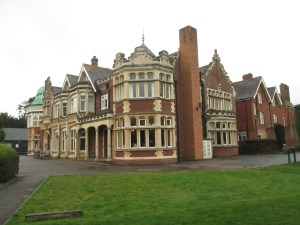
Bletchley Park – a taster

The weekend before last I attended the Convention held 11th to 13th October. It was my first, having been away from amateur radio for more than thirty years until my serious return in February 2018.

On Friday 11th I took the time during the day to visit Bletchley Park, which should perhaps be the subject for another post.

The Convention started with a welcome dinner, self-service, on the evening of 11th, sponsored by Martin Lynch. There was a choice but I had the “Indian”, which was fine.

The following morning the lectures began, and most I attended were in the VHF stream, starting with an interesting talk by Simon Watts, G3XXH, about Airborne Maritime Reconnaissance Radars for the RAF, 1946 to 2010. I slipped out for the HF propagation talk by Gwyn Williams, G4FKH before returning to VHF for the report on the IC9700 by Sam Jewell, G4DDK. I was most interested as I have just bought one. In the end I was not sure whether he thought the rig was a super DX machine for VHF. I will have to make up my own mind in due course.

After lunch on the Saturday I attended the talk by Chris Deacon, G4IFX on polarisation of 50 MHz signals via Sporadic E, the one by Marcus Walden G0IJZ about tropo ducts, and later the presentation by Richard Banester, G4CDN concerning 2m ionoscatter. Fascinating stuff.

In the evening there was a formal dinner which was good, but I did not stay for the after-dinner address as I was very tired.

After breakfast on Sunday, probably the best meal of the day, we heard from Noel Matthews, G8GTZ, about EME from the 32m dish at Goonhilly, which was very entertaining, and then from Chris Whitmarsh, G0FDZ about working 122 GHz and up. Something for the really clever guys! Neil Smith G4DBN then spoke about decoding with MGM (if I can hear it, why won’t it decode?) and after lunch he also spoke about getting started with MGM, substituting for M1BXF who was unwell. I hope he is better now.

That was the end of my Convention, which I enjoyed, and which was good value for money, I thought. In between the lectures I had time to visit the various stands. Martin Lynch as sponsors had a long bench, and Icom, Yaesu and Kenwood were also represented. There was a substantial RSGB bookstall where I bought my book on the IC9700 (very useful), and in another room various organisations were represented, such as RAIBC, CDXC, and the UK Microwave Group.

I am looking forward to next year. It was a very rainy weekend, but we did not have to brave the weather as all walkways between the buildings were covered. The accommodation was adequate although I did have a couple of issues with my room, but that is a minor complaint. All-in-all, time well spent.

2 metre tropo on 14th and 15th September

20190916_215503We had an interesting opening over the evening of 14th and the following morning. It started with a couple of very strong French stations in JN18. I then found the following all worked on SSB on 14th:

DL2GWZ/P   JN49

OE5XBL   JN68, 700m asl, 988 km

DF6MH/P  JN57 2400m asl, 902km

DJ6AG   JO51

On the morning of 15th when there was a contest in Central Europe:

OM3RM   JN88  1263 km!

OE3REC   JN77  1147 km

OK1DOL   JN69   906 km

F5LEN/P   JN38

OE/OK5SE/P   JN77  1137 km

OK1KKI   JN79   1059 km

Plus, some more local Continentals.

My return to 2 metres SSB after 30 years absence was only in February 2018, so OE, OK and OM are new countries on the band for me from this QTH. The Slovak Republic was a particular surprise, being so strong and my thinking he was Belgian until he gave his locator. It was early and I was still half asleep; at least that is my excuse.

The above was my first DX foray with my FT991 running 50 watts rather than the 25 watts from my old FT290R and small amplifier, but I am not mothballing the old radio and will keep it ready to go.